TL;DR
- CVS Pharmacy fills e-prescriptions from telehealth providers, including GLP-1 medications like Zepbound, Wegovy, and Ozempic, but insurance approvals and dose-level stock gaps routinely add days most patients don't plan for.
- Most GLP-1 prescriptions route to CVS Specialty Pharmacy, not the retail counter. That single distinction explains the majority of "why isn't my medication ready" phone calls we field.
- Count backward, don't wait. Add up prior authorization time, fill time, and shipping, then start your refill request that many days before your last dose. We walk the arithmetic below.
- Coverage depends on your plan, not on CVS. Some plans cover GLP-1s only with a Type 2 diabetes diagnosis, some require prior authorization for weight management, and some exclude weight loss entirely.
- Home delivery through a telehealth pharmacy partner skips the counter, which matters most for refills you want to arrive on a predictable schedule.
Standing in a CVS Pharmacy line for twenty minutes to hear "we don't have that dose, check back Thursday" is the single most common complaint we hear from new GLP-1 patients. It isn't really a CVS failure. It's a supply, insurance, and routing problem that shows up at every retail counter in the country, and it has a handful of predictable causes, the same causes that make comparing options among the best telehealth providers in the United States worthwhile before you pick where your prescriptions get sent. Here's what's actually happening behind the glass, and how to route around it.
How does CVS Pharmacy receive prescriptions from telehealth providers?
Exactly the way it receives any other prescription. Your provider transmits it electronically through an e-prescribing network, and it drops into the queue at whichever CVS location you named. No fax, no paper script, no extra step on your end.
The complication is where it lands. GLP-1s and other injectables often get routed to CVS Specialty Pharmacy instead of your neighborhood counter, even though the sign out front says CVS Pharmacy. Specialty handles drugs that need refrigerated storage, prior authorization paperwork, and manufacturer coordination. GLP-1s check all three boxes. If your prescriber sends the script to retail but your plan requires specialty fulfillment, it can bounce between the two before anyone thinks to call you.
When you start care with a telehealth platform like Top Weight Loss Med, your provider will ask whether you want the prescription sent to a local pharmacy or shipped to your home. Saying "local pharmacy" and naming your usual CVS is enough. Confirm the street address though. We see patients pick the CVS inside a Target ten minutes past the one they actually meant, then wonder why nothing showed up in their app.

What's the difference between CVS Pharmacy and CVS Specialty Pharmacy?
CVS Pharmacy is the retail counter in your local store, the one filling antibiotics and blood pressure pills same day. CVS Specialty Pharmacy is a separate operation built for high-cost, high-touch medications: biologics, injectables, and most GLP-1 weight loss drugs.
Specialty fulfillment usually means an intake phone call from a specialty pharmacist before your first shipment, a prior authorization check with your insurer, and delivery by courier rather than in-store pickup. That's not a downgrade. Once it's running, it's often the faster of the two, because you're not competing with the flu-shot line. But the first fill takes longer than people expect, which is where the frustration starts.
Pro tip: If the CVS Specialty intake call goes to voicemail and you sit on it for a few days, some plans will let the prior authorization request go stale and you'll restart the approval. Answer the unknown number. Set a reminder if you have to.
How do you get your GLP-1 prescription filled without losing a day off work?
Treat it as a chain of handoffs, because that's what it is, and every handoff is a place a day disappears. Work these in order.
- Lock in your pharmacy before the visit ends. Have the exact CVS Pharmacy address ready, or say you want home delivery. Check the hours while you're at it. Pharmacy counters close well before the store does, and CVS locations inside Target tend to keep shorter pharmacy hours than free-standing stores.
- Ask out loud whether the drug routes to retail or specialty. GLP-1s almost always go specialty. If the system defaults to a retail store, flag it in the visit. This one question prevents the "my prescription vanished" call better than anything else on this list.
- Start prior authorization the same day. Most plans require PA for GLP-1 coverage. A provider who documents your BMI, weight history, prior attempts, and relevant conditions in the first note gives the request its best shot. Thin documentation is the number one reason we see a PA come back with a denial that then eats another week on appeal.
- Respond to the stock message immediately. Zepbound, Wegovy, and Ozempic have all gone through periods where specific strengths were hard to find. When CVS texts that your dose isn't available, answer it. Reserved doses get released back to general stock after a set window.
- Be home for cold-chain delivery. Specialty shipments arrive with gel packs on a tight window. A pen baking on a porch in July is a wasted month of therapy, and replacement requests are a headache nobody enjoys.
- Request refills early, not on your last dose. See the arithmetic in the next section.
- Keep a backup. If your store is chronically out, ask your provider about a different CVS a few miles over, a Walgreens, or a mail pharmacy partner. Chains don't share inventory problems evenly, and switching once beats calling weekly.
Show the math: when should you actually request your refill?
Here's the calculation we walk patients through, using an illustrative scenario you can re-run with your own plan's numbers.
A typical GLP-1 box holds four weekly pens, so one box is a 28-day supply. Now add up the three lead times in front of you:
- Prior authorization renewal, if yours is expiring: call it 7 business days
- Pharmacy processing and fill: 2 business days
- Cold-chain shipping: 2 business days
That's 11 business days, which is roughly 15 calendar days once you account for weekends.
28 − 15 = day 13. In other words, if your PA is up for renewal, you should be poking the pharmacy about halfway through your current box, not at the end.
If your PA is already good for the year, drop that 7 days out and you're at 28 − 6 = day 22, or about five days before your last pen. That's the number most people should be working from.
The rule of thumb: if your prior authorization expires within the next 60 days, start every refill request at the midpoint of your current box. If it doesn't, one week out is fine.
What most people miss
The biggest mistake isn't skipping a step. It's assuming the process runs on autopilot once the script is sent. Prior authorizations expire. Dose strengths go in and out of stock independently, so your 5 mg pen can be sitting on the shelf while the 7.5 mg is three weeks out. And a "ready for pickup" notification in the app doesn't always mean specialty cleared your insurance. Sometimes it just means the retail system logged the script and is waiting for a hand-off that never happened.
If a week passes with no real update, call. Don't wait for a text.
Pro tip: Save the direct line for your specific CVS Specialty branch instead of the general 1-800 number. The direct line gets you someone who can actually see your order and your PA status rather than a rep reading from a script.
Does CVS Pharmacy accept insurance for GLP-1 medications?
Yes. Both retail CVS and CVS Specialty process insurance claims for GLP-1s. Whether the claim pays is a different question, and it comes down to your plan design, not the pharmacy.
Three patterns cover most of what we see:
- Diabetes-only coverage. The plan pays for a GLP-1 with a Type 2 diagnosis and denies the same drug written for weight management. Same molecule, different answer.
- Covered with prior authorization. The plan will pay for weight management, but wants documented BMI, comorbidities, and sometimes a documented lifestyle-intervention attempt before it approves.
- Categorical exclusion. The employer carved weight loss drugs out of the formulary entirely. No appeal gets you around this one, and no pharmacy can fix it. Self-pay or a different medication class are the real options.
If the claim rejects or the copay lands somewhere absurd, self-pay at CVS is possible, though brand-name GLP-1 cash prices are steep enough that most patients start looking at manufacturer savings programs, single-dose vial programs, or a different formulation instead. Bring the actual CVS quote back to your provider rather than just walking away from it. A savings card or a different presentation of the same drug can change the number substantially. Our FAQs page covers how insurance and self-pay both work when you start with us.
Is home delivery faster than picking up at CVS Pharmacy?
For GLP-1s and other specialty prescriptions, usually yes. Home delivery through a telehealth provider's pharmacy partner skips the in-store queue and the phone-tag stock checks, and it gives you a tracking number instead of a guess.
Retail pickup still wins in a few situations:
- Same-day fills for everyday medications such as antibiotics, birth control refills, and standard maintenance drugs that never touch specialty routing.
- Talking to a pharmacist face to face about an interaction or a side effect while you're standing there.
- Grabbing the rest of the kit in one trip: sharps container, alcohol swabs, electrolyte packets, a food scale.
- Late hours and multiple locations when you need something tonight and your usual pharmacy is dark.
Here's the honest comparison for a GLP-1 or another specialty prescription. The timelines below reflect what we typically see with our patients, not a published standard.
| Factor | CVS Pharmacy pickup | Home delivery via telehealth |
|---|---|---|
| Typical first fill | About a week, most of it PA processing | A few business days after approval |
| Refill turnaround | Same day if in stock, longer if backordered | Ships on a set schedule before you run out |
| Stock visibility | You call or check the app yourself | Partner confirms the dose before shipping |
| Cold-chain handling | Stored refrigerated, pick up the day it's ready | Insulated packaging, someone must be home |
| Who chases the insurer | Often you, between two departments | Handled with the prescribing team |
| Best for | Immediate pickup, in-person questions | Predictable monthly refills |
Frequently asked questions
Can I transfer my prescription from CVS to a different pharmacy?
Yes. Pharmacies transfer most prescriptions between locations and between chains, though controlled substances carry stricter federal limits. Call the new pharmacy, not the old one, and give them your current pharmacy's name, address, and the prescription details. They handle the request from there. Transfers usually go through faster than people expect, often the same day.
What if my CVS Pharmacy is out of my GLP-1 dose?
Ask the pharmacist to check nearby stores, since inventory varies location to location within the same chain. If your area has been short for weeks rather than days, that's a signal to change strategy, not to keep calling. Talk to your telehealth provider about dosing options or moving future fills to a pharmacy partner that ships directly, which takes local retail stock out of the equation.
Does CVS Pharmacy work with telehealth platforms for other prescriptions, like birth control or hair loss treatment?
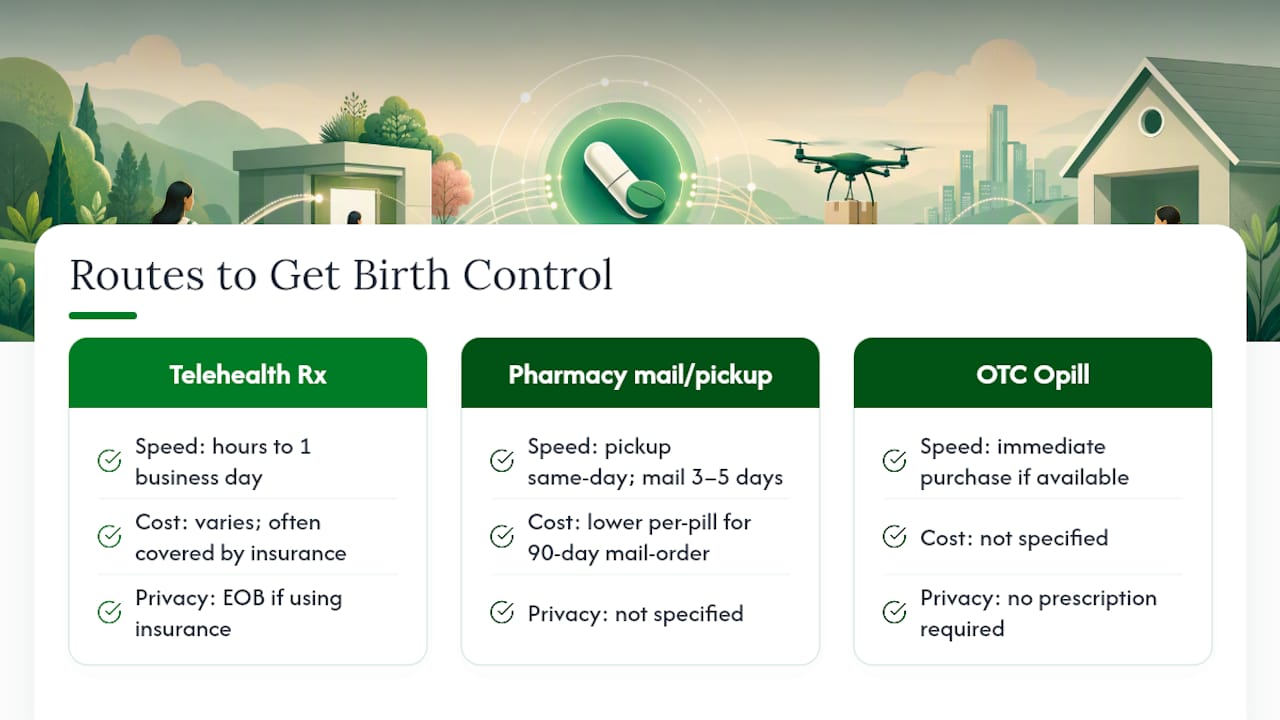
Yes. Routine e-prescriptions from a telehealth visit, including birth control and hair loss medications, fill at retail CVS the same way any prescription does, usually same day if it's on the shelf. None of them require the specialty routing GLP-1s trigger, which is why refills for something like hair loss treatment move through a retail counter in hours while an injectable takes days.
Before your next visit, do one thing: pull up your plan's formulary and find out whether GLP-1s are covered for weight management, covered only for diabetes, or excluded. That answer determines everything downstream, including whether CVS is even the right pickup point for you. Start a visit with Top Weight Loss Med and tell your provider what you found, along with whether you want the prescription shipped to your door or sent to your usual CVS. You'll know the routing before you ever stand in line.