TL;DR
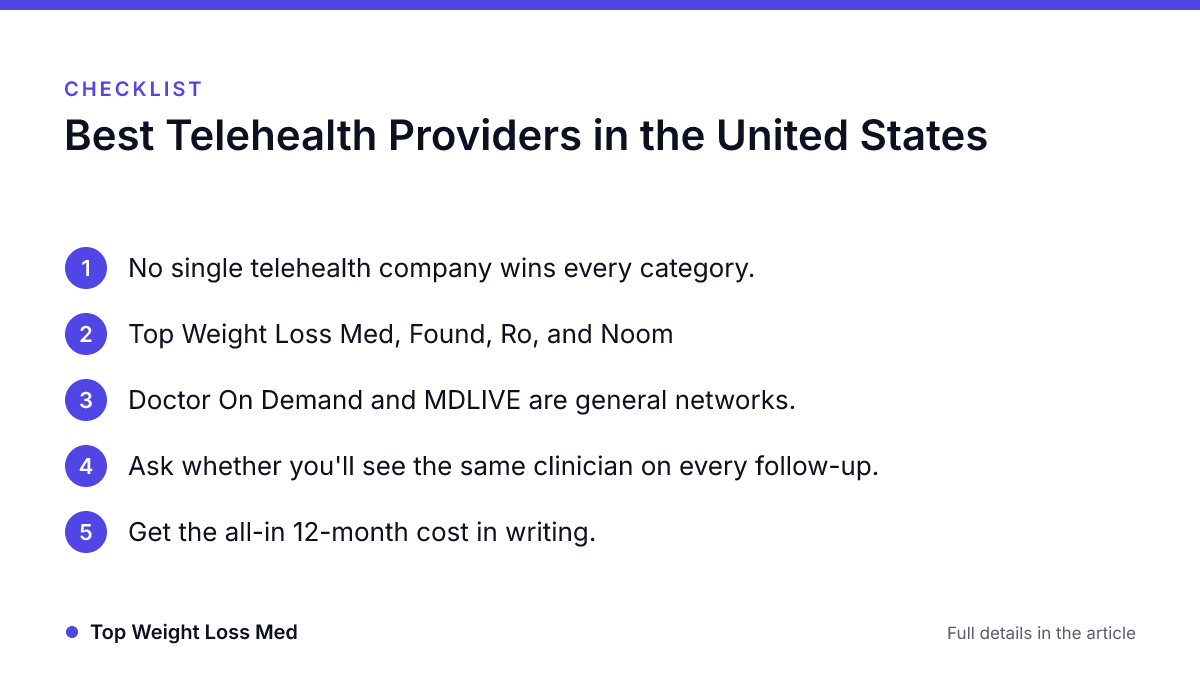
- No single telehealth company wins every category. Weight loss with GLP-1 medication, general urgent care, and mental health each have different leaders worth comparing before you hand over a credit card.
- Top Weight Loss Med, Found, Ro, and Noom all prescribe GLP-1 medications online, but they differ on coaching, insurance acceptance, and how many other conditions they treat.
- Doctor On Demand and MDLIVE are general networks. Good for a same-day sore throat or a therapy session, not built around long-term weight loss medication management.
- Ask whether you'll see the same clinician on every follow-up. Platforms that rotate you through a pool of prescribers make you re-explain your history each visit, which slows down dose adjustments.
- Get the all-in 12-month cost in writing. A $40 copay four times a year is $160 in visit fees; a $99/month membership is $1,188. Neither number tells you what the medication itself will cost.
If you're searching for the best telehealth provider in the United States, you've probably already seen the same six or seven names: Teladoc, Amwell, Ro, Noom, Found, MDLIVE. Here's the honest answer nobody selling you a subscription will give you. The winner changes depending on what you're treating.
For GLP-1 weight loss care, platforms built around metabolic health tend to beat general networks, because specialized telehealth services integrate behavior change support and lifestyle strategies alongside prescription medications instead of ending the relationship at the prescription. For a rash, a UTI, or a standing therapy appointment, a broad network makes more sense. What actually decides it for you: the condition, whether the provider holds a license in your state, and whether the pricing model survives contact with a full year of care rather than one visit.
Who are the top telehealth providers?
They split into two camps.
Condition-specific platforms (Top Weight Loss Med, Found, Ro, Noom) build the entire intake, follow-up cadence, and coaching library around a narrow slice of medicine: weight loss, men's health, behavior change. General-purpose networks (Doctor On Demand, MDLIVE, Teladoc Health, Amwell) cover primary care, urgent care, dermatology, and mental health, usually through employer or health plan partnerships.
Neither camp is better in the abstract. Someone who needs a psychiatric consult this afternoon should go to a broad network with mental health clinicians on staff. Someone starting a GLP-1 who wants to message a coach at 9pm about nausea after a dose increase should go to a weight-loss platform. Using the wrong one is how people end up paying for a subscription they cancel in six weeks.
Pro tip: Search the provider's name plus your state before you create an account. Several platforms advertise "nationwide" coverage but have gaps for specific conditions, and you'll only find out after you've entered payment information.
What are the best telemedicine services for weight loss, men's health, and mental health?
It depends on the category, so compare them side by side rather than by which homepage looks nicest.
| Provider | Primary focus | Pricing approach | What to verify before you sign up |
|---|---|---|---|
| Top Weight Loss Med | GLP-1 weight loss, ED, birth control, hair loss, skincare, primary care, anxiety and depression | Insurance or self-pay, same-day or scheduled video visits | Current medication availability, whether your plan is accepted |
| Found | Weight loss medication plus a behavior coaching app | Self-pay membership | Coaching frequency, cancellation terms, insurance options |
| Doctor On Demand | Urgent care, primary care, mental health | Often billed through employer or health plan | Whether weight loss medication is offered on your plan at all |
| MDLIVE | Urgent care, dermatology, therapy | Insurance-integrated, copay-based | Specialist availability for hormone or weight care |
| Ro | Men's and women's health, weight loss, ED, hair loss | Self-pay memberships | Insurance acceptance, refill and reorder logistics |
| Noom | Psychology-based coaching app with a medical prescribing arm | App subscription plus separate medical fees | How the medical visit connects to the coaching side |
Pro tip: "Starting at $X" almost never includes the drug. Ask for the number that combines visit fee, medication, and any coaching add-on. That's the only figure worth comparing across platforms.
How do you check a telehealth provider's credentials before you book?
The same way you'd vet an in-person doctor. Ask who's prescribing, how long they've practiced, and whether they'll still be your clinician in six months.
Plenty of platforms route you to whoever is available. That's fine for a Z-Pak. It's a real problem for weight management, where the prescriber needs to remember that your last dose increase gave you three days of nausea and that you're already on a blood pressure medication. We keep the same prescriber on your chart for exactly that reason.
Five questions worth asking any platform:
- Who prescribes, and what's their background? Physicians, nurse practitioners, and physician assistants all prescribe legitimately; you just want to know which one you're getting and how long they've been doing it.
- Will I see the same clinician at follow-ups, or does the system assign a new one each time?
- Are they licensed in my state for this specific condition? Rules for controlled substances and hormone therapy vary state by state.
- What happens if the medication isn't working? Is there a scheduled check-in to adjust the dose, or do you have to chase it down yourself?
- Who answers messages between visits, and what's the realistic response time on a side effect question?
GoodRx's roundup of telehealth apps is a decent starting point for comparing intake flows. The credential questions above usually aren't answered on a marketing page, so plan on emailing support.
How do pricing and insurance coverage really compare?
Three models, roughly: insurance-billed with a copay, flat self-pay membership, and hybrid platforms that run the visit through insurance and bill medication separately.
Run the math before you pick. Here's an illustrative scenario.
Platform A bills your insurance and you owe a $40 copay per visit. Medication management visits happen quarterly, so four visits a year:
$40 × 4 = $160 per year in visit fees.
Platform B charges $99/month self-pay, bundling the visit and coaching:
$99 × 12 = $1,188 per year.
Platform A looks like an easy win, by more than a thousand dollars. Then you check whether your plan covers the GLP-1 itself. If it doesn't, you're paying cash price for the drug on top of that $160, and the medication line item is the one that decides everything. The visit fee is rounding error by comparison.
The rule of thumb: whichever platform gets your medication covered, or gets you the lowest cash price on it, is the cheaper platform. Ask both for a 12-month total that includes visits, medication, and coaching before you compare anything.
Pro tip: Ask whether the platform bills your plan directly or whether you pay upfront and file for reimbursement. Same total cost, very different hit to your checking account in January.
Top Weight Loss Med takes both insurance and self-pay. You can review current options for weight loss treatment or check the FAQs page for how billing works before your first visit.
Do telehealth patients get results as good as in-person care?
For medication management and behavior-driven conditions, results hinge on what happens between visits, not on whether the visit was in a room or on a screen. Healthline's review of telehealth companies notes that specialized telehealth services integrate behavior change support and lifestyle strategies alongside prescription medications for weight management. That pairing is the differentiator.
Here's what it looks like in practice. The week after a dose increase is when most people struggle: nausea, early fullness, sometimes constipation, and a quiet temptation to skip the next shot. A patient who can message a coach that week gets practical fixes (protein first, smaller portions, slow down at dinner, hydration) and stays on schedule. A patient with no one to message often stops the medication and never tells anyone. That's the gap coaching closes, and it's why we pair prescriptions with unlimited coach messaging rather than a quarterly check-in.
For one-off issues, a sinus infection or a birth control refill, the in-person question barely matters. A video visit does the job.
How fast can you actually get your prescription filled?
The video visit is the fast part. Everything after it depends on your pharmacy, your insurance, and stock.
Three things slow people down more than the appointment:
- Prior authorization. If your plan requires one for a GLP-1, expect several business days between the prescription being sent and the pharmacy being able to fill it. Start the paperwork the same day, not after the first rejection.
- Local stock. High-demand injectables move in and out of availability by store, not by chain. Your neighborhood CVS being out says nothing about the one two miles away.
- Mail-order routing. Some plans force specialty medications through their own mail pharmacy, which adds shipping time you can't shortcut with a same-day visit.
Pro tip: If the pharmacy says your medication is "on order," ask them to check the wholesaler ETA and give you the specific date. If it's more than a couple of days out, ask us to route the script to a different pharmacy instead of waiting. Most people sit on hold for a week they didn't need to lose.
We break down turnaround times in more detail in our guide on whether CVS Pharmacy fills telehealth prescriptions fast.
Which telehealth provider should you actually pick?
Start with the condition, then narrow by price and service model.
Need GLP-1 medication with coaching, insurance flexibility, and same-day visits? Top Weight Loss Med is built for that. Want an app-first behavior program with prescribing bolted on? Noom or Found. Need urgent care and therapy in the same place, with occasional prescriptions? Doctor On Demand or MDLIVE cover more territory.
If men's health is the priority, ED treatment or enclomiphene for testosterone support, compare Ro's structure against our ED treatment page and look specifically at follow-up cadence, not the intro price.
Whatever you pick, read the reviews and check the about page for prescriber credentials before you enter payment information. That's the five-minute step most people skip and later regret.
Frequently asked questions
Is Teladoc the same thing as Teladoc Health, and should I use it for weight loss?
Teladoc is the consumer-facing brand of Teladoc Health, a large general network covering primary care, mental health, and dermatology along with some chronic condition management. It can work for weight loss if you want broad insurance partnerships, but ask specifically whether your plan's weight track includes GLP-1 prescribing and ongoing coaching. That varies by employer and plan, not just by company.
Can I use telehealth without insurance?
Yes. Most platforms, including Top Weight Loss Med, offer self-pay pricing, so insurance isn't a requirement for care. If you're comparing options without insurance, ask each platform for the self-pay total including medication. The visit fee is where they all look similar; the drug cost is where they diverge.
Does United HealthCare cover telehealth visits and GLP-1 medications?
It depends on your specific plan and formulary, so check your plan documents or call member services to confirm coverage, copay, and any prior authorization requirement. Many telehealth providers can bill your plan directly once you enter your insurance details at signup, which is worth confirming before your first appointment rather than after.
Do this today: pull up your insurance card, call the member services number, and ask two questions. Is telehealth covered, and is a GLP-1 on your formulary? Then create an account with Top Weight Loss Med and book a visit. Walking in with those two answers turns a guessing game into a decision.