Tretinoin is a prescription retinoid that is already the active form of vitamin A in skin. Retinol is an over-the-counter ingredient that skin has to convert before it works. That is why tretinoin is generally stronger, faster and more irritating, and why retinol is easier to buy and usually gentler. Neither one is automatically “best.” The right choice depends on what you are treating, how your skin tolerates it, and whether you will use it consistently.
Below, we explain how each works, what the research says about how they compare, how to start either one, and when a prescription is worth it.
TL;DR
- Tretinoin (the active ingredient in Retin-A) is prescription-only in the United States. Retinol is sold over the counter.
- Tretinoin is retinoic acid itself. Retinol needs two conversion steps in the skin to become retinoic acid, so it is usually slower and less predictable.
- A 12-week split-face study found no significant difference between specially formulated retinol and matched tretinoin strengths. That result does not cover every retinol serum on the shelf.
- Both can dry, redden and peel skin, and irritation is generally more likely with tretinoin. Start slowly and wear sunscreen every day.
- Moderate to severe acne, or retinol that has stopped working for you, are good reasons to ask a clinician about tretinoin.
Table of Contents
- What tretinoin and retinol actually are
- Tretinoin vs. retinol at a glance
- Is tretinoin stronger than retinol?
- Side effects and irritation
- Which one is right for you?
- How to start either one
- Cost and access
- Our perspective
- Talk to a provider about your skin
- FAQ
- Sources
What tretinoin and retinol actually are
Both are retinoids, a family of molecules derived from or similar to vitamin A. A clinician’s guide to topical retinoids lays out the chain: retinyl esters become retinol, retinol becomes retinaldehyde (retinal), and retinaldehyde becomes retinoic acid. Retinoic acid is the form that actually signals skin cells to behave differently.
Tretinoin is all-trans retinoic acid. It sits at the end of that chain, so nothing has to happen in your skin before it starts working. Retinol sits near the start. Retinaldehyde needs one conversion step, and retinol needs two.

That is the real difference. Tretinoin is not just a “stronger retinol” in the way a 2% serum is stronger than a 1% serum. It is a different point on the same pathway.
Where Retin-A fits
Retin-A is a brand name for tretinoin, not a separate ingredient. Other U.S. brand names include Retin-A Micro, Altreno, Atralin and Refissa, plus generic tretinoin, according to Drugs.com patient guidance. If someone says “Retin-A vs. tretinoin,” they are describing the same molecule. The brand, strength and vehicle (cream, gel or lotion) can differ.
Tretinoin vs. retinol at a glance
| Tretinoin | Retinol | |
|---|---|---|
| Availability in the U.S. | Prescription only | Over the counter |
| Form in skin | Retinoic acid, already active | Must convert to retinaldehyde, then retinoic acid |
| Typical strength | Generally more potent | Generally milder |
| FDA-labeled uses | Acne; adjunct for fine facial wrinkles, roughness and mottled hyperpigmentation | Sold as a cosmetic, no prescription needed |
| Irritation | Generally more likely and more pronounced | Usually gentler, still possible |
| Predictability | Standardized drug products | Varies by brand, stability and formula |
| Who decides the product | A clinician | You |
The FDA-labeled uses above come from U.S. clinical references. The strengths most often discussed in the literature are 0.025%, 0.05% and 0.1%. The right product and strength take a clinician’s assessment.
Is tretinoin stronger than retinol?
In general, yes. Tretinoin acts directly and has the larger clinical evidence base. Clinical reviews describe it as the best-established topical retinoid for photoaging.
The picture is less tidy once you look at actual products. A randomized, double-blind, split-face study gave 65 people with moderate to severe photodamage retinol at 0.25%, 0.5% or 1.0% on one side of the face and tretinoin at 0.025%, 0.05% or 0.1% on the other. After 12 weeks, both improved wrinkles, brightness, pigmentation and roughness, and the researchers found no significant efficacy difference between matched groups.
Three things keep that from being a green light to swap one for the other:
- The retinol in that study was a specially formulated sustained-release product, not a typical drugstore serum.
- A percentage on a label is not a reliable potency comparison across brands. Stability, vehicle and release technology all change what reaches your skin.
- A systematic review of over-the-counter vitamin A products found that four of nine vehicle-controlled trials showed no statistically significant difference between the retinol product and its vehicle.
The takeaway: a well-made retinol can perform respectably, but you cannot assume yours does. With tretinoin, the product is standardized.
Side effects and irritation
Both ingredients can cause dryness, redness, peeling and stinging. The American Academy of Dermatology notes these effects are generally more likely or more pronounced with tretinoin. StatPearls lists itching, skin pain and irritation among the most common effects of topical tretinoin.
Irritation matters for a practical reason: people who get red and flaky in week two often quit before the benefit shows up. Tretinoin microsphere formulations were developed partly to improve tolerability and adherence.
What helps, according to dermatology guidance:
- Apply to dry skin, using a small amount.
- Introduce it gradually rather than nightly from day one.
- Pair it with a gentle cleanser and a moisturizer.
- Wear broad-spectrum sunscreen every morning.
- Do not use more product, or use it more often, to speed things up. It increases irritation, not results.
If you want to know what to expect from the early weeks of tretinoin in particular, our guide to the tretinoin purge timeline walks through it.
When to hold off or call someone
Do not apply tretinoin to sunburned, severely inflamed, eczematous or broken skin. The AAD also advises that people with substantial redness or inflammation should address that problem first, because a retinoid can worsen irritation and hide what is really going on. If you think you might have rosacea, for example, see a clinician before layering on a retinoid. Severe or persistent reactions deserve medical advice.
If you are pregnant, planning a pregnancy or breastfeeding, ask your clinician before using either product. Pregnancy and breastfeeding status is one of the factors that shapes which product is appropriate.
Which one is right for you?
The AAD says an over-the-counter retinol or retinoid product can be a good fit for mild acne, mild pigmentation irregularities or mild fine lines. Prescription tretinoin makes more sense when a clinician decides you need a stronger, better-evidenced treatment, or when over-the-counter products have not given you enough improvement.
Retinol is a reasonable place to start if:
- Your concerns are mild: early fine lines, a little uneven tone, occasional breakouts.
- Your skin is dry or reactive and you want the gentlest on-ramp.
- You want to try a retinoid without a visit.
Tretinoin is worth asking about if:
- You have persistent or moderate to severe acne. Tretinoin has an FDA-labeled acne indication, and retinol does not. For other acne routes, see our overview of online acne treatment in the U.S.
- You have visible sun damage: mottled pigmentation, roughness, fine wrinkles.
- You have used a retinol consistently for several months and see little change.
- You want a standardized product instead of guessing across serums.
If your main frustration is dark marks that linger after breakouts or sun exposure, hyperpigmentation treatment from dermatologists online is a related path worth reading about.
Using retinol and tretinoin together
You generally do not need both. Layering them adds irritation without a clear benefit. Pick one active retinoid at a time, and let a clinician guide any switch from one to the other.
If retinoids are too much for your skin
Some skin simply does not tolerate retinoids well, and that is fine. If you want to explore gentler anti-aging approaches, this piece on anti-aging options without retinol covers some alternatives, and it also clarifies that Retin-A is a tretinoin brand rather than a different ingredient.
How to start either one
This is a general schedule based on the dermatology guidance above, not a prescription. A clinician may give you different instructions for your skin, and the directions on your product come first.
- Wash and wait. Cleanse gently and let your skin dry completely before applying.
- Use a small amount. The AAD advises a small amount; more does not work faster.
- Go slowly. Begin with a few nights a week and add nights only as your skin settles.
- Moisturize. Use a moisturizer to manage dryness and peeling.
- Protect in the morning. Apply broad-spectrum sunscreen daily. Retinoids make sun protection more important, not optional.
- Give it time. Skin changes from retinoids show up over weeks to months. The study above measured at 4, 8 and 12 weeks.
Cost and access
Retinol is cheap to try and available on any shelf. Tretinoin requires a prescription, and what you pay depends on the formulation, pharmacy and insurance. Our breakdown of what patients actually pay for tretinoin with insurance covers the details.
Our perspective
We see the same pattern with skincare questions. People arrive after months of trying serums, unsure whether the problem is the product, the dose or their own consistency. Our view is that the “tretinoin vs. retinol” debate is less about a winner and more about fit.
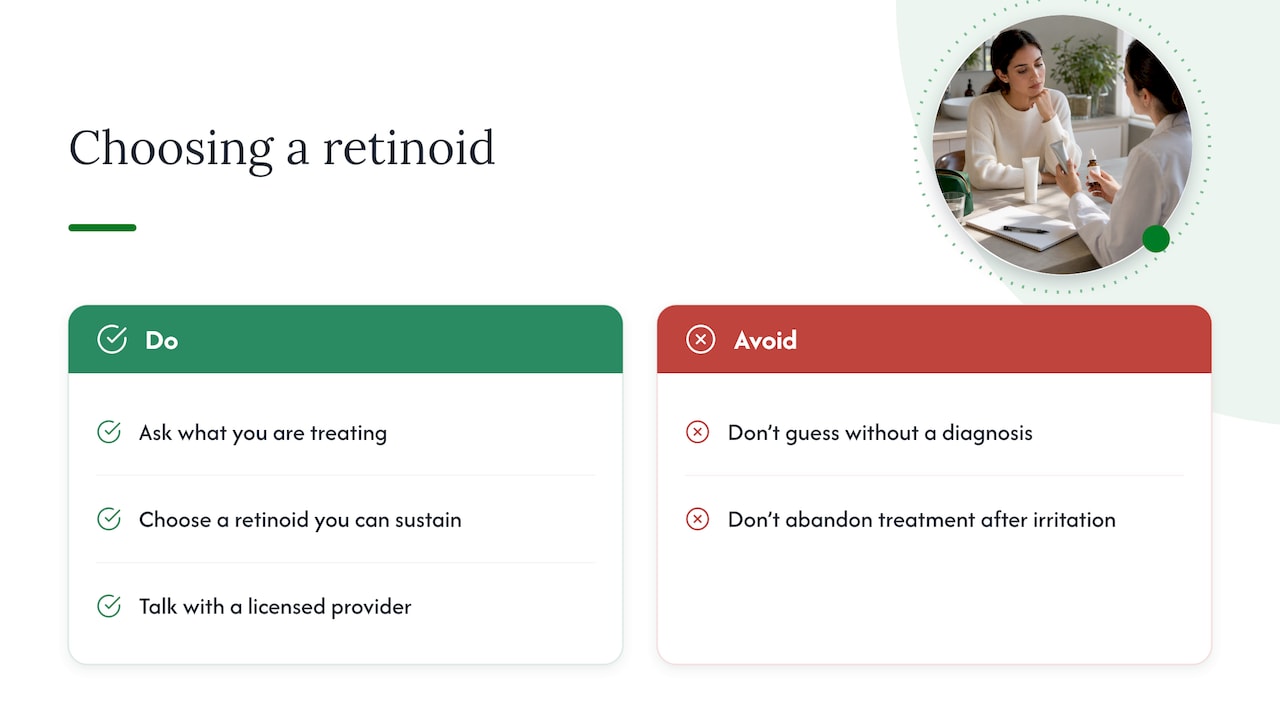
We think the most useful question is not “which is stronger?” It is “what am I treating, and can I stick with it?” A gentle retinol you use every week beats a prescription you abandon in week two because it burned. And a retinol that has plateaued after several months is a fair reason to talk to a clinician about tretinoin, rather than buying a fifth serum.
That is also why we think this belongs in a conversation with a licensed provider, not a guessing game. Diagnosis matters: acne, rosacea and pigmentation can look alike and need different plans. Pregnancy plans, current products and sun habits all change the answer. A provider can look at the whole picture, choose a product and strength, and adjust if your skin pushes back.
— Bryan
Talk to a provider about your skin
If you are weighing prescription options, our skincare service lets you start with an online visit instead of an in-person appointment. A provider can review your concerns and discuss whether a prescription treatment fits you. Pricing for skincare is not published on our site, so check the page for current details.
FAQ
Is Retin-A the same as tretinoin?
Yes. Retin-A is a brand name, and tretinoin is the active ingredient. Other brands and generics contain it too, and they can differ in strength and vehicle. In the U.S., all of them require a prescription.
Is Retin-A available over the counter?
No. In the United States, Retin-A and other tretinoin products are prescription-only. Retinol is the nonprescription vitamin A derivative found in many serums and creams. If a product says retinol, it is not tretinoin.
Can I use tretinoin and retinol together?
You generally do not need to. Using both on the same skin tends to add dryness, redness and peeling without a clear extra benefit. Choose one retinoid at a time and ask your clinician before switching.
Is tretinoin safe while breastfeeding?
This is a question for your own clinician rather than a general yes or no. Pregnancy and breastfeeding status is one of the factors that guides which retinoid is appropriate, so tell your provider before starting any retinoid. They can recommend an option that fits your situation.
Does retinol work as well as tretinoin?
Sometimes, but not reliably. In one 12-week study, specially formulated retinol matched tretinoin, but that does not apply to every over-the-counter product. Tretinoin is generally more potent, while retinol is usually gentler and slower.
Sources
- A Clinician’s Guide to Topical Retinoids, PMC
- U.S. clinical references, National Center for Biotechnology Information
- Randomized, double-blind, split-face study of retinol-based vs. tretinoin-based products, PubMed
- Retinoid or retinol?, American Academy of Dermatology
- Stieva-A Cream Forte Topical: Key Safety & Patient Guidance, Drugs.com
- Cosmetic retinoid use in photoaged skin: A review, PMC
- Evidence for the Efficacy of Over-the-counter Vitamin A Cosmetic Products: A Systematic Review, PMC
- Tretinoin, StatPearls, NCBI Bookshelf