With commercial insurance and an acne diagnosis, most patients pay $0–$30 for generic tretinoin at the pharmacy counter. Brand-name Retin-A is a different story: prior authorization is common, and without it, you could face the full retail price, which can exceed $200. The single most important variable is whether your prescriber submitted an acne diagnosis code rather than a cosmetic one.
Three things you can do right now to lower your cost:
- Ask for generic tretinoin. It covers the same active ingredient and lands in a lower formulary tier at most commercial plans.
- Compare your insurance copay to a GoodRx or SingleCare coupon at the register. Coupons cannot be combined with insurance, but they sometimes beat your copay outright, especially if you have a high-deductible plan.
- Confirm your prescriber listed acne vulgaris as the diagnosis. Insurers including UnitedHealthcare and Medicare Part D cover tretinoin for acne but not for cosmetic uses like photoaging.
Pro Tip: Before you leave the pharmacy, ask the pharmacist to price your prescription two ways: once through your insurance and once with the best available coupon. It takes 60 seconds and can save you real money.
What does tretinoin cost with insurance vs. paying cash?
Price varies more than most patients expect. Drugs.com lists tretinoin topical prices ranging from $15.19 to $567.04 depending on strength, formulation, and pharmacy. That spread reflects real-world variation: a 20 g tube of 0.025% cream at a discount pharmacy is a very different purchase than a 45 g tube of 0.1% gel at a hospital outpatient pharmacy.

| Product | Cash price (no discount) | With GoodRx/SingleCare coupon | Typical insured copay (acne Dx) |
|---|---|---|---|
| Generic tretinoin 0.025% cream, 45 g | ranges widely in cash price | coupons often reduce cost notably | insured copays are generally low for acne diagnosis |
| Generic tretinoin 0.025% cream, 45 g | ranges widely in cash price | coupons often reduce cost notably | insured copays are generally low for acne diagnosis |
| Generic tretinoin 0.1% gel, 20 g | ranges widely in cash price | coupons often reduce cost notably | insured copays are generally low for acne diagnosis |
| Brand Retin-A / Retin-A Micro | cash prices can be higher | occasional promotions may reduce price | insured copays tend to be higher and prior authorization may be required. |
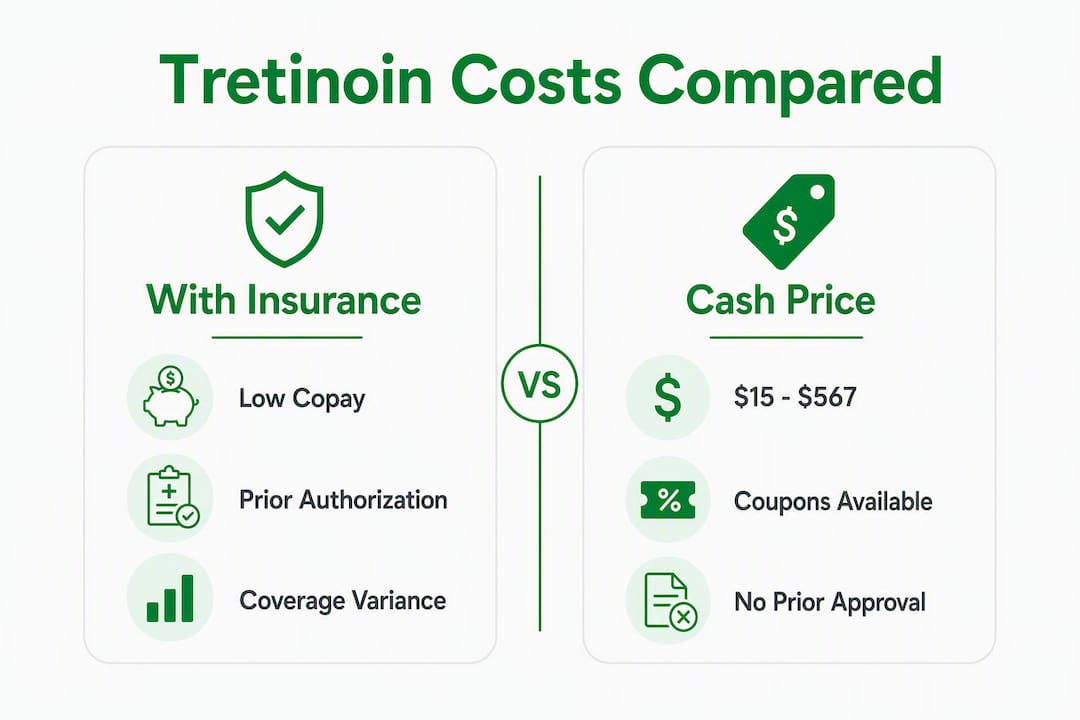
Concentration and tube size shift the price noticeably. A 20 g tube costs less than a 45 g tube, but the per-gram price is often higher. Gel formulations tend to run a few dollars more than cream at the same strength. Formulary coverage can also differ by formulation: your plan might cover the cream but not the gel, or vice versa, so always check your specific prescription against your plan’s drug list.
Out-of-pocket scenarios worth knowing:
- Low-deductible commercial plan: Generic tretinoin for acne typically lands at a Tier 1 or Tier 2 copay, often $5–$30 per fill.
- High-deductible plan, early in the year: You pay the negotiated rate until you hit your deductible. That can mean $40–$80 for generic tretinoin before insurance kicks in.
- Medicare Part D: Generic tretinoin for acne is generally covered; the 2026 Part D out-of-pocket cap is $2,100, which limits catastrophic exposure but does not eliminate cost-sharing at the pharmacy.
How do insurers decide whether to cover tretinoin?
The coverage decision starts with one question: is this medically necessary or cosmetic? UnitedHealthcare’s policy explicitly approves topical retinoids for non-cosmetic medical conditions and excludes cosmetic indications. Medicare Part D follows the same logic. That means the diagnosis code your prescriber submits is not a formality — it is the gate.
Here is the path a typical prescription takes:
- Prescription arrives at the pharmacy benefit manager (PBM).
- PBM checks the formulary: is this drug listed, and at what tier?
- If a prior authorization flag exists, the PBM sends a request to the prescriber before dispensing.
- Step therapy check: does the plan require trying a generic before approving a brand?
- Quantity limit check: does the fill exceed the plan’s allowed days’ supply or tube count?
- If all checks pass, the copay is calculated and the patient is billed.
Formulary tiers matter because they set your cost-sharing percentage. Generic tretinoin usually sits at Tier 1 or Tier 2, where copays are lowest. Brand-name Retin-A or Retin-A Micro often lands at Tier 3 or higher, where coinsurance (a percentage of the drug’s cost rather than a flat dollar amount) can make the bill significantly larger.
Deductibles add another layer. If you have not met your annual deductible, you pay the full negotiated rate even for a covered drug. Once you cross the deductible, cost-sharing drops to your copay or coinsurance. Reaching your plan’s out-of-pocket maximum eliminates cost-sharing entirely for the rest of the plan year.
Key policy point: UnitedHealthcare automatically adjudicates topical retinoid prescriptions for members under 30 without a manual coverage review, which means younger patients with a straightforward acne diagnosis often skip the prior authorization step entirely.
What barriers can delay or increase your cost?
Prior authorization is the most common friction point for brand-name tretinoin. Insurers and PBMs routinely require clinical documentation before approving a branded product, and that process takes time.
Common barriers:
- Prior authorization: Required for most brand-name formulations; sometimes triggered for high-strength generics.
- Step therapy: Your plan may require documented failure or intolerance of a generic before approving a brand.
- Quantity limits: Many plans cap fills at a 30-day supply or one tube per fill, which affects how often you return to the pharmacy.
- Specialty pharmacy routing: Some plans require brand-name topicals to be filled at a designated specialty pharmacy rather than your local drugstore.
- Mail-order mandates: A few plans require 90-day fills to go through a mail-order pharmacy after the first fill.
Typical timeline when prior authorization is required:
- Prescriber submits PA request (Day 1).
- Insurer acknowledges receipt (Day 1–2).
- Insurer reviews clinical documentation (Day 2–7 for standard review; up to 14 days if documentation is incomplete).
- Approval or denial issued (Day 3–14).
- If denied, prescriber files appeal or submits additional records (adds 5–30 days).
To shorten that window: have your prescriber submit the PA the same day they write the prescription, include documentation of any prior generic tretinoin use, and confirm the acne vulgaris diagnosis code is on the request. A call from your local pharmacist to the prescriber’s office can also move things faster than waiting for fax queues.
How to check your plan and estimate your actual out-of-pocket cost
Before you call anyone, gather these items:
- Your insurance card (plan name, member ID, Rx BIN, PCN, and Group number).
- The exact prescription: drug name, strength, formulation (cream/gel), and quantity.
- Your diagnosis (acne vulgaris if that applies).
- Your plan’s formulary or drug list (usually downloadable from your insurer’s member portal).
Then work through this checklist:
- Search your formulary online. Log into your insurer’s member portal, search “tretinoin,” and note the tier and any PA or step-therapy flags next to your specific formulation.
- Call the insurer’s pharmacy help line. Ask: “Is tretinoin [strength/formulation] covered under my plan? What tier? Is prior authorization required? What is my copay or coinsurance?”
- Go to the pharmacy and ask them to run it two ways. First through your insurance, then with a GoodRx or SingleCare coupon. Coupons cannot be combined with insurance, but the coupon price sometimes beats the insured copay, particularly for high-deductible plans.
- Confirm PA or step-therapy requirements with your prescriber. If the formulary flags either, call your prescriber’s office and ask them to submit the PA before you pick up the prescription.
- Check your deductible status. If you have not met your deductible, you will pay the negotiated rate, not the copay. Your insurer’s member portal shows your year-to-date deductible progress.
Pro Tip: When you call the insurer’s pharmacy line, ask specifically: “Does my plan require step therapy for this drug, and if so, what documentation does my prescriber need to submit?” Getting that answer upfront saves a week of back-and-forth.

Practical ways to lower your tretinoin cost even with insurance
Generic is the fastest lever. Generic tretinoin contains the same active ingredient as Retin-A and typically costs far less, both in cash price and in insured copay tier.
Beyond that:
- GoodRx and SingleCare coupons: Generic tretinoin 0.025% cream (45 g) is often available at discounted coupon prices at major retail pharmacies. If your insured copay is higher than that, use the coupon instead.
- Manufacturer copay cards: For brand-name products like Retin-A Micro, manufacturer savings programs can reduce copays substantially for commercially insured patients. These programs are not available to Medicare or Medicaid enrollees, so eligibility must be confirmed before enrolling.
- 90-day or mail-order fills: Many plans offer a lower per-unit cost for 90-day supplies. Mail-order pharmacies often pass additional savings to the patient.
- Pharmacy shopping: Cash prices vary significantly across pharmacies. Running a GoodRx search across nearby pharmacies takes two minutes and can reveal a $20–$30 difference for the same tube.
- Patient assistance programs: The HealthWell Foundation, NeedyMeds, and the Medicine Assistance Tool help uninsured or underinsured patients identify manufacturer programs and financial assistance options.
- Ask about samples: Dermatology and primary care offices sometimes have manufacturer samples, which can cover a month’s supply while a PA is pending.
What major insurers actually do: UnitedHealthcare, Cigna, and Medicare Part D
Policy language matters here because it tells you exactly what to expect and what to say when you call.
UnitedHealthcare covers topical retinoids when prescribed for non-cosmetic medical conditions. Its prior authorization policy explicitly excludes cosmetic indications and automatically adjudicates prescriptions for members under 30 with covered indications, bypassing manual review for that age group.
From UnitedHealthcare’s topical retinoid PA policy: Topical retinoid products are approved for non-cosmetic medical conditions. Prescriptions for members younger than 30 years are automatically adjudicated for covered indications without a coverage review.
Cigna and most other large commercial plans apply similar medical necessity standards. Cosmetic use is explicitly excluded; acne vulgaris and actinic keratosis are the most commonly covered indications. Step therapy requiring a documented generic trial before brand approval is standard practice across these plans.
Medicare Part D covers generic tretinoin when prescribed for acne. It does not cover tretinoin for cosmetic purposes, and that distinction is enforced at the PBM level through diagnosis code review. The 2026 Part D out-of-pocket cap of $2,100 applies to all covered Part D drugs, including tretinoin, which limits total annual exposure for patients who need ongoing treatment.
Key points for using this information:
- When your prescriber writes a PA, ask them to cite the specific covered indication (acne vulgaris) and reference the insurer’s policy language.
- If you are under 30 and on a UnitedHealthcare plan, confirm with your pharmacist that automatic adjudication applies to your specific formulation.
- Medicare patients should ask their Part D plan sponsor for the formulary tier and any quantity limits before filling.
Pro Tip: Print or screenshot the insurer’s PA policy page and bring it to your prescriber’s office. It tells them exactly what language to use in the clinical justification, which speeds approval.
What to do if your insurance denies coverage
A denial is not the end. Most are overturned when the right documentation is submitted.
- Get the denial in writing. Ask the pharmacy or insurer for a detailed denial letter that states the specific reason (cosmetic exclusion, PA required, step therapy not met, quantity limit exceeded).
- Call your prescriber the same day. Share the denial reason and ask them to submit a prior authorization or clinical justification letter that directly addresses it.
- File an internal appeal. Every insurer is required to have an internal appeal process. Submit the appeal with supporting documentation: medical records, photos if relevant, and documentation of any prior treatments tried.
- Request an external review if the internal appeal fails. Under the Affordable Care Act, you have the right to an independent external review for most coverage denials.
- Ask about expedited review. If waiting for a standard appeal would seriously harm your health, request an expedited review, which typically must be resolved within 72 hours.
While the appeal is pending, you have options. Use a GoodRx or SingleCare coupon to fill a smaller quantity at cash price. Ask your prescriber for a sample. Or ask whether a different covered formulation (a different strength or cream vs. gel) would achieve the same clinical result and is already on your formulary.
Pro Tip: The most common reason a PA is denied is a mismatch between the diagnosis code submitted and the insurer’s covered indication list. Before your prescriber resubmits, confirm the exact ICD-10 code they plan to use and cross-check it against the insurer’s policy.
Key Takeaways
Generic tretinoin copays typically run $0–$30 with most commercial plans; brand Retin-A often requires prior authorization and costs more. | Diagnosis code is the gate | Insurers cover tretinoin for acne, not cosmetic use; the ICD-10 code your prescriber submits determines coverage. | | Coupons sometimes win | GoodRx/SingleCare coupons for 45 g generic can sometimes beat insurance copays for high-deductible or Medicare patients. | | PA and step therapy are common for brands | Document prior generic use before requesting brand approval to speed the prior authorization process. | | Topweightlossmed simplifies the process | Topweightlossmed’s virtual clinicians handle PA submissions, correct diagnosis coding, and pharmacy coordination in one visit. |
A note on navigating tretinoin coverage
The part of this process that frustrates patients most is not the cost itself — it is the gap between getting a prescription and actually having it in hand. Prior authorization delays, step-therapy requirements, and formulary mismatches are all solvable, but they require someone to follow up, submit the right documentation, and know which levers to pull.
What I have seen consistently is that patients who get help from a clinician familiar with insurer PA workflows move through the process faster and with fewer denials. The diagnosis code, the clinical justification language, the documentation of prior treatment — these are not details a patient should have to manage alone. When a provider handles them correctly from the start, the approval rate goes up and the wait time goes down.
There is also a real case for checking coupon pricing even when you have insurance. The assumption that insurance always gives the best price is wrong often enough that it is worth verifying every time, especially early in the plan year when deductibles are still open. A two-minute check at the pharmacy counter is a habit worth building.
Topweightlossmed can handle the insurance work for you
Getting tretinoin covered is not complicated when someone who knows the system handles it for you. Topweightlossmed’s skincare telehealth service connects you with licensed clinicians who write prescriptions with the correct diagnosis codes, submit prior authorization requests directly to your insurer, and coordinate fills at your preferred pharmacy or through mail-order delivery.
The process is straightforward: sign up online, complete a same-day virtual visit, and your prescription goes to the pharmacy of your choice. If your plan requires a PA, the clinical team handles the submission and follow-up. If a coupon beats your copay, the team can flag that too.
Topweightlossmed works with major insurance plans and can verify your coverage before your visit. Prescriptions follow medical necessity standards, and all clinical decisions are made by licensed providers. To get started, book a virtual skincare visit today.
This article provides general information only, not medical or insurance advice. Verify your specific plan benefits with your insurer and confirm treatment decisions with a licensed clinician.
Where to check prices, insurer policies, and patient assistance programs
These are the most useful resources for verifying your out-of-pocket cost and finding help:
- GoodRx: Search tretinoin by strength and zip code to compare coupon prices across nearby pharmacies. Free to use; no account required.
- SingleCare: Similar coupon tool with competitive pricing on generic tretinoin; also publishes insurance coverage guides.
- Drugs.com price guide: Lists cash prices by dose and pharmacy; useful for benchmarking before you call your insurer.
- UnitedHealthcare provider PA policy: The actual policy document your insurer uses to approve or deny topical retinoid prescriptions.
- Medicare.gov: Use the plan finder tool to check Part D formulary coverage and tier placement for your specific plan.
- NeedyMeds: Searchable database of patient assistance programs by drug name; free to use.
- Medicine Assistance Tool: PhRMA-sponsored tool that connects patients to manufacturer assistance programs.
- MedlinePlus tretinoin page: NIH-maintained drug information page with clinical details, dosing, and safety information.
FAQ
Does insurance cover tretinoin for acne?
Yes. Most commercial plans and Medicare Part D cover generic tretinoin when it is prescribed for acne vulgaris. Coverage is denied when the indication is cosmetic, such as photoaging, so the diagnosis code your prescriber submits is critical.
Generic tretinoin for acne typically costs $0–$30 per fill with commercial insurance. High-deductible plans may charge the full negotiated rate (often $40–$80 for generic) until the deductible is met. Brand-name Retin-A copays are usually higher and require prior authorization.
Is tretinoin better than retinol for acne and dark spots?
Tretinoin is a prescription-strength retinoic acid that works faster and at lower concentrations than over-the-counter retinol, which must be converted by the skin before it becomes active. For acne and post-inflammatory hyperpigmentation, tretinoin 0.1% is clinically effective, though it requires a prescription and can cause initial irritation.
Do you need a prescription to get tretinoin?
Yes. Tretinoin is a prescription-only medication in the United States. It is available as a cream, gel, or lotion in concentrations ranging from 0.025% to 0.1%, and a licensed provider must write the prescription before a pharmacy can dispense it.
Can GoodRx coupons be used with insurance for tretinoin?
No. GoodRx and SingleCare coupons cannot be combined with insurance at the same transaction. However, the coupon price sometimes comes out lower than your insured copay, particularly for high-deductible plans or Medicare patients, so it is worth asking your pharmacist to price both options before you pay.