Yes, telehealth is covered by most U.S. insurers in 2026, but the details differ by payer. Medicare covers a wide range of virtual visits through at least December 31, 2027, with standard Part B cost-sharing. Medicaid covers telehealth in every state, though services and payment rules vary. Private plans cover it too, but your copay depends on whether you’re using an in-network doctor or a standalone telehealth vendor. Before you book, call your insurer to confirm your specific benefit.
TL;DR:
- Most Medicare telehealth services are covered until at least December 31, 2027, with beneficiaries paying similar coinsurance as for in-person visits.
- Medicaid reimbursement policies vary significantly by state, with differences in modality coverage, provider eligibility, and reimbursement rates affecting access.
- Private insurers generally offer telehealth coverage in nearly all states, but payment parity is less common, often leading to lower reimbursements for virtual visits.
- Provider licensing restrictions require patients to be in the same state where the provider is licensed, which can disrupt care during travel or if licensing rules change.
- Verifying coverage before booking is essential, as benefits depend heavily on your plan, insurer, and state rules, and there is little automatic assurance of coverage or cost predictability.
Table of Contents
- Telehealth Insurance Coverage Under Medicare: What’s Actually Paid For
- Medicaid Telehealth Coverage Varies Sharply by State
- Private Insurance and Telehealth: Coverage Parity vs. Payment Parity
- How to Verify Coverage Before Your Telehealth Visit
- What Telehealth Actually Costs You Out of Pocket
- Where You’re Sitting Determines Who Can Treat You
- Where Telehealth Insurance Coverage Runs Out
- Tracking Telehealth Policy Changes for 2026 and Beyond
- How Topweightlossmed Handles Insured Telehealth Visits
- Telehealth’s Bigger Role in Mental Health and Substance Use Treatment
- Apps, Wearables, and Remote Monitoring: Does Insurance Pay for Those?
- Employer Health Plans and Telehealth: The Overlooked Layer
- Why Verification Beats Assumption Every Time
- Get Insured Telehealth Care Through Topweightlossmed
- Sources
- FAQ
Telehealth Insurance Coverage Under Medicare: What’s Actually Paid For
Medicare’s telehealth coverage is broader than most beneficiaries realize, and it’s also more time-sensitive than people assume. Through December 31, 2027, Medicare covers many telehealth services that beneficiaries can receive from the comfort of home, not just from a rural clinic or medical facility as older rules once required.
That 2027 date matters. It reflects a temporary extension of pandemic-era flexibilities, not a permanent fix, which means the rules could tighten again once that window closes unless Congress or CMS acts first.
Here’s what Medicare Part B typically covers under current telehealth policy:
- Behavioral health visits, including therapy and psychiatric medication management, delivered by video or audio.
- E-visits and virtual check-ins, brief communications with your regular provider about an existing condition.
- Select therapy and rehab services, such as certain physical therapy and occupational therapy follow-ups.
- Primary care and specialist consultations, when the provider bills the visit as a covered telehealth service.
- Remote patient monitoring, used for chronic conditions like hypertension or diabetes, billed under specific CMS provider guidance for remote patient monitoring.
Cost-sharing works the same way it does for in-person Medicare visits. After you meet your Part B deductible, you’ll generally pay 20% coinsurance for covered telehealth services. There’s no special telehealth discount built into Original Medicare.
Medicare Advantage plans are a different story. Many MA plans add telehealth benefits beyond what Original Medicare offers, and some include $0 copays for virtual visits as a plan perk designed to compete for enrollees. If you’re on a Medicare Advantage plan, your telehealth costs could look nothing like your neighbor’s Original Medicare bill, even for the identical service.
Pro Tip: Before scheduling, ask the practice directly whether they bill Medicare for telehealth and whether they participate as a Medicare provider. Not every virtual-care platform does, and finding out after the visit is the wrong time to ask.
Because these rules shift with each rulemaking cycle, don’t rely on last year’s blog post. Check CMS.gov directly, or watch for updates in the Federal Register for the CY 2026 physician fee schedule finalized rules, which govern exactly which codes and services qualify.
Medicaid Telehealth Coverage Varies Sharply by State
Medicaid reimburses telehealth in all 50 states and Washington D.C., but that universal floor hides enormous variation in what’s actually paid for and how. A scoping review of telehealth reimbursement policy found that while every state Medicaid program offers some telehealth reimbursement, covered modalities and provider eligibility differ widely from one state line to the next.
That variation shows up in a few predictable places:
- Modality coverage. Some states pay for audio-only visits (a phone call, essentially); others require live video and won’t reimburse a phone-only consult at all.
- Store-and-forward services. Sending images or data for a provider to review later (common in dermatology and some specialty consults) is covered in some states and excluded in others.
- Remote patient monitoring. A handful of states have built out RPM billing codes for chronic disease management; many haven’t.
- Provider type restrictions. Certain states limit which license types (nurse practitioners, licensed clinical social workers, psychologists) can bill Medicaid for telehealth.
- Originating site rules. A few states still restrict where the patient must be located to qualify, even though the federal government relaxed this for Medicare.
Payment parity, not just coverage, drives whether providers actually offer telehealth to Medicaid enrollees. If a state reimburses telehealth visits at a fraction of the in-person rate, providers have less financial incentive to offer virtual appointments to Medicaid patients, even when the coverage technically exists on paper. This is one of the quiet reasons some Medicaid enrollees report having a harder time finding a telehealth appointment than someone with a private PPO plan a few counties over.
If you’re on Medicaid, don’t guess. Check your specific state Medicaid agency’s website, or use a policy tracker like the Center for Connected Health Policy to see current modality and reimbursement rules for your state. Rules here change often enough that a state summary from two years ago may already be outdated.
Private Insurance and Telehealth: Coverage Parity vs. Payment Parity
Private insurance covers telehealth almost everywhere now, but the word “covers” hides a two-tier system that catches a lot of people off guard. As of the most recent NCSL tracking, 43 states plus D.C. have enacted some form of telehealth private insurance law, and 41 states plus D.C. mandate coverage parity, meaning insurers must cover telehealth if they cover the equivalent in-person service.
Coverage parity is not the same thing as payment parity. Coverage parity just means the insurer has to pay for the visit somehow. Payment parity requires the insurer to pay the same rate for a telehealth visit as it would for an identical in-person visit. Fewer states require payment parity, and where it’s absent, insurers can reimburse providers at a lower rate for virtual care, which sometimes discourages providers from offering it at all.
In practice, most employer-sponsored and marketplace plans run on a two-tier structure:
- Standalone telehealth vendor benefits, often bundled into the plan at low or no cost, used for quick, general medical questions.
- In-network telehealth visits with your regular physician, which typically apply your normal deductible, copay, or coinsurance just like an office visit would.
This split explains why one telehealth visit might cost you nothing and another might land you a $40 copay, even under the same insurance card. The vendor visit and the in-network physician visit are billed completely differently, even though both happen over video.
There’s one more wrinkle worth knowing: self-funded employer plans governed by ERISA are exempt from state insurance mandates, including telehealth parity laws. If your employer self-funds its health plan (common at larger companies), state telehealth coverage requirements may not apply to you at all. Your Summary of Benefits and Coverage, not your state’s telehealth law, is the document that actually governs your benefit in that case.
How to Verify Coverage Before Your Telehealth Visit
Confirming coverage takes five minutes on the phone and can save you a surprise bill weeks later. Follow this order:
- Call the number on the back of your insurance card, not a general customer service line, and ask specifically whether telehealth visits are covered for the service you need.
- Ask for the expected copay or coinsurance amount for that specific visit type, and whether it differs from an in-person visit for the same issue.
- Confirm the provider or platform is in-network. A telehealth company can be legitimate and still be entirely out-of-network for your plan.
- Ask the provider directly whether they bill insurance for the visit or require self-pay, and whether they accept Medicare or Medicaid if that applies to you.
- Confirm state licensure. Ask if the provider is licensed to treat patients physically located in your state.
- Record the representative’s name and a reference number from your insurer call, in case you need to appeal a denied claim later.
HHS guidance on paying for telehealth recommends this exact approach: call before the appointment, ask specific coverage and cost questions, and don’t assume a virtual visit is automatically cheaper just because it’s virtual.
Pro Tip: Ask your insurer to confirm coverage using the specific CPT code the provider plans to bill, not just “telehealth” as a general category. Codes determine reimbursement, and a rep confirming general telehealth coverage isn’t the same as confirming your specific service is covered.
What Telehealth Actually Costs You Out of Pocket
Telehealth copays generally track whatever your plan already charges for the same type of visit, whether that’s a standalone vendor consult, a primary care appointment, or a specialist visit. A quick virtual check-in through a bundled vendor benefit often costs nothing. An in-network telehealth visit with your regular doctor usually applies your standard copay or coinsurance, and a teletherapy session can run anywhere from a modest copay to full specialist cost-sharing depending on your plan design.
For Medicare beneficiaries, the math is more predictable: after your annual Part B deductible, you’ll pay 20% coinsurance on covered telehealth services, same as an in-person Part B service.
A few cost mechanics worth knowing:
- Telehealth payments generally count toward your deductible and out-of-pocket maximum, just like in-person care.
- HSA and FSA funds can typically be used to pay telehealth copays and coinsurance, since telehealth is treated as a qualified medical expense.
- Some high-deductible health plans allow certain telehealth services to be covered before the deductible is met, a carve-out some employers add specifically to encourage early care.
- Medicare Advantage plans and in-network vendor benefits tend to carry the lowest telehealth copays, sometimes $0, making them worth checking before you assume a virtual visit will cost the same as an office visit.
If cost is your main concern, ask your HR benefits contact or insurer whether your plan has a designated low-cost telehealth vendor built in before you book with an outside provider.
Where You’re Sitting Determines Who Can Treat You
Telehealth licensure rules hinge on one fact that trips up a lot of patients: the provider generally must be licensed in the state where you, the patient, are physically located during the visit, not the state where the provider’s office sits. If you’re an Ohio patient logging into a virtual appointment while visiting family in Florida, your Ohio-licensed provider may not legally be able to treat you during that call.

The Interstate Medical Licensure Compact speeds this up for participating physicians by creating an expedited pathway to obtain licenses in multiple compact states, rather than applying state by state from scratch. It doesn’t eliminate the licensing requirement, but it makes multistate practice far more practical for doctors who join.
A few practical implications:
- Traveling can interrupt your care. If you rely on a telehealth therapist or primary care provider and cross state lines for an extended trip, your regular provider may not be able to see you until you return.
- Some states issued temporary telehealth waivers during and after the COVID-19 emergency; most of those have since expired, so don’t assume a waiver you read about years ago still applies.
- Ask upfront which states your provider is licensed in, especially if you split time between two states or travel frequently for work.
Where Telehealth Insurance Coverage Runs Out
Even generous telehealth policies have limits, and knowing them ahead of time keeps you from an unexpected bill or a denied claim. The most common exclusions include:
- International providers. A consultation with a doctor licensed outside the U.S. generally isn’t reimbursable under U.S. insurance, regardless of plan type.
- Out-of-network telehealth companies. Being “telehealth” doesn’t override your plan’s network rules; an out-of-network virtual visit is billed like any other out-of-network care.
- Certain elective or cosmetic services. These typically aren’t covered whether delivered virtually or in person.
- Services requiring in-person follow-up. Some procedures and diagnostic steps can’t legally or practically be completed over video, and insurers won’t reimburse a virtual attempt at them.
- Store-and-forward or RPM limits. Depending on your state and payer, these modalities may carry stricter coverage rules than live video visits.
- Prior authorization requirements and visit caps. Even a fully covered service can be denied if your plan requires prior authorization you didn’t obtain, or if you’ve exceeded an annual visit limit.
Tracking Telehealth Policy Changes for 2026 and Beyond
Telehealth coverage has been a moving target since 2020, and 2026 is no exception. Pandemic-era flexibilities were extended repeatedly through temporary Congressional action, and CMS has layered rulemaking on top of those extensions each year, most recently through the CY 2026 physician fee schedule finalized in the Federal Register.
Many current Medicare telehealth provisions are time-limited by design, tied to specific expiration dates like the December 31, 2027 window mentioned earlier, rather than made permanent. That’s a legislative choice, not an oversight, and it means the rules genuinely could change again before that date arrives.
For the most reliable updates, go straight to primary sources instead of secondhand summaries:
- CMS.gov for the current list of covered Medicare telehealth services.
- Telehealth for federal policy updates and provider guidance.
- Federalregister for finalized rulemaking text.
- NCSL’s telehealth explainer series for state-by-state private insurance law summaries.
- Your state Medicaid agency and state insurance department websites for rules specific to your coverage.
How Topweightlossmed Handles Insured Telehealth Visits
Topweightlossmed offers virtual care across primary care, mental health, and weight loss management, with medication delivery built into the same platform so patients aren’t juggling separate portals for a diagnosis and a prescription. The platform accepts insurance for many patients, allowing some to use their existing coverage rather than paying entirely out of pocket for care.
Before your visit, Topweightlossmed’s team can help confirm whether your specific plan applies. Patients review and agree to telehealth care terms through the Consent to Telehealth process, which outlines how virtual visits and billing work on the platform.
When you contact Topweightlossmed about insurance, have your insurance card, your plan’s member services number, and a short description of the service you’re seeking ready. That’s usually enough to get a same-day answer on whether your visit is covered.
Telehealth’s Bigger Role in Mental Health and Substance Use Treatment
Mental health and substance use disorder treatment have arguably benefited from telehealth’s insurance expansion more than any other specialty. Therapy and psychiatric medication management were among the first services insurers moved to fully cover under video and audio visits, partly because clinical outcomes for talk therapy translate reasonably well to a screen, and partly because behavioral health provider shortages made virtual access an obvious pressure valve.
Medicare’s behavioral health telehealth coverage, detailed earlier, reflects this shift directly. Medicaid programs across most states have similarly prioritized behavioral health as one of the more consistently covered telehealth categories, even in states that restrict other modalities more tightly.
Substance use disorder treatment carries its own nuance. Certain medication-assisted treatment protocols, including some controlled substance prescribing for opioid use disorder, have specific federal rules governing whether an initial visit can happen entirely by telehealth or requires an in-person component first. Those rules have shifted more than once in recent years, so patients seeking MAT specifically should confirm current requirements with their provider rather than assuming last year’s rule still applies.
If you’re evaluating a telepsychiatry provider, ask the same coverage questions you’d ask for any telehealth visit: is the provider in-network, does your plan apply standard mental health cost-sharing, and does the platform bill your insurer directly. A closer look at telepsychiatry insurance coverage walks through what patients typically pay and how to verify benefits ahead of a first session.
Apps, Wearables, and Remote Monitoring: Does Insurance Pay for Those?
Coverage for smartphone-based telehealth and remote patient monitoring (RPM) has expanded, but it’s billed differently than a standard video visit, and that distinction matters for what shows up on your bill.
A live video consult through an app is billed like any other telehealth visit, subject to the same coverage and cost-sharing rules already discussed. Remote patient monitoring, where a connected device (a blood pressure cuff, glucose monitor, or weight scale) transmits data to your provider between visits, uses entirely separate billing codes. Medicare has specific guidance covering which provider types can bill for RPM and under what conditions, generally requiring a minimum number of monitoring days per month and an interactive check-in with the patient.
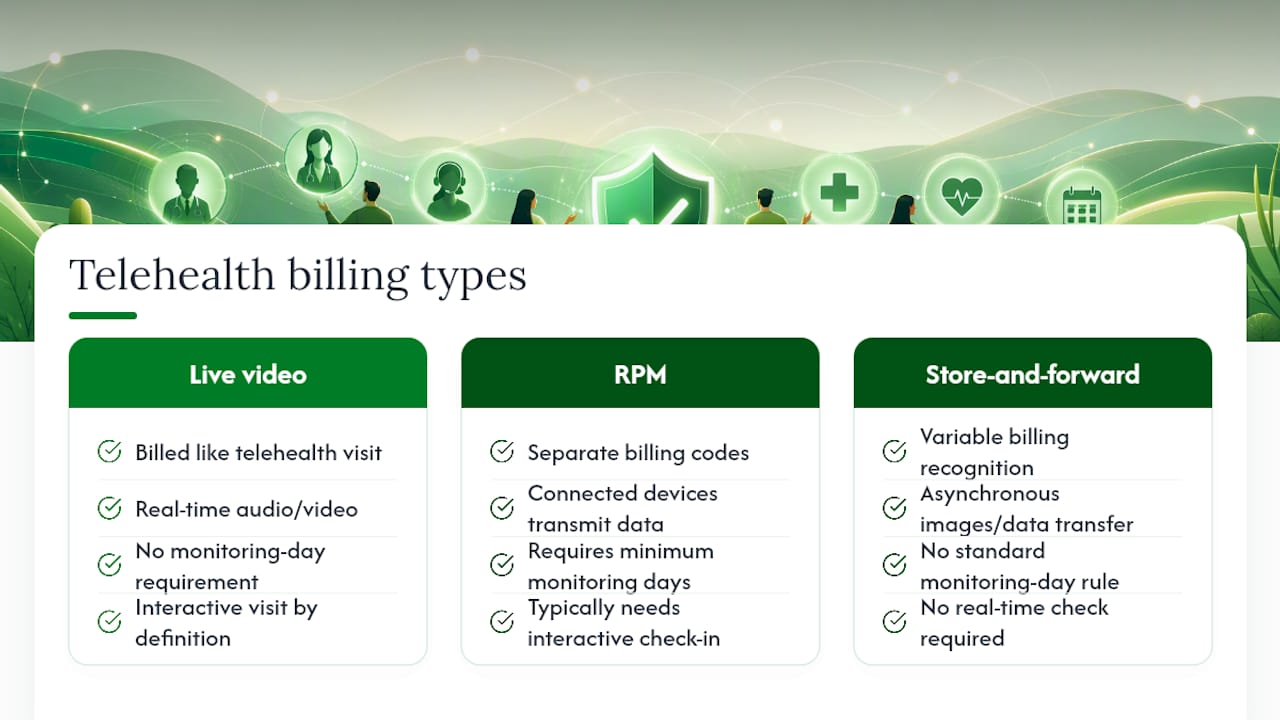
Not every payer covers RPM the same way. Some private plans cover it enthusiastically as a chronic-disease management tool because it can reduce costly complications down the line. Others still treat it as a newer benefit with narrower criteria, sometimes limited to specific diagnoses like heart failure or diabetes.
Store-and-forward services, where images or data are sent for a provider to review later rather than in real time, face the widest gap in coverage. Some state Medicaid programs and private payers reimburse this readily; others don’t recognize it as a billable telehealth modality at all. If your care plan depends on a monitoring device or an app-based data transfer rather than live video, confirm the specific billing code with your provider’s office before assuming it’s automatically covered.
Employer Health Plans and Telehealth: The Overlooked Layer
Employer-sponsored telehealth benefits often run alongside, not instead of, your main medical plan, and understanding that overlap prevents confusion at the pharmacy counter or the billing desk. Many employers add a standalone telehealth vendor as a low-cost perk, giving employees $0 or near-$0 access to general medical advice, while your primary insurance plan still handles anything more involved, like a specialist referral or an ongoing chronic condition.
This is the same two-tier structure described earlier in the private insurance section, but it’s worth flagging specifically for employer plans because HR departments don’t always explain it clearly during open enrollment. Employees frequently assume the free vendor perk covers everything telehealth-related, then get surprised when a virtual visit with their actual primary care doctor comes with a standard copay.
Self-funded employer plans add another layer of complexity. Because ERISA exempts these plans from state insurance mandates, a company’s internal benefits decisions, not your state’s telehealth parity law, determine what’s covered and at what rate. If you work for a large employer that administers its own health plan, your Summary of Benefits and Coverage document is the only reliable source for how telehealth is actually treated. Two employees living in the same state, working for different companies, can have meaningfully different telehealth benefits purely because one company self-funds and the other doesn’t.
If you’re unsure which category your employer plan falls into, ask your HR benefits administrator directly whether the plan is self-funded or fully insured. That one question tells you whether your state’s telehealth laws even apply to you.
Why Verification Beats Assumption Every Time
The conventional advice on telehealth coverage treats it as a solved problem: insurance covers it now, so just book the visit. That advice was closer to true in 2021, when emergency flexibilities blanketed almost everything. It’s not accurate anymore. The system has fragmented into Medicare rules with a hard 2027 expiration date, fifty different Medicaid programs, and private plans split between vendor benefits and in-network physician visits that bill completely differently.
What gets underestimated is how much the payment parity gap, not the coverage parity headline, actually shapes your experience. A state can proudly claim it “covers” telehealth while reimbursing providers so poorly that good clinicians simply stop offering it. Coverage on paper and access in practice are not the same thing, and most consumer guides conflate them.
My honest read: the five-minute phone call to your insurer before booking isn’t optional caution anymore, it’s the actual product of understanding this system. Skip it, and you’re gambling on a patchwork of federal deadlines, state modality rules, and employer plan structures that even benefits professionals find confusing.
— Bryan
Get Insured Telehealth Care Through Topweightlossmed
If you’ve read this far, you already know the real work is verifying your specific benefit before you book, not assuming coverage exists because you saw “insurance accepted” on a website. Topweightlossmed makes that step easier by partnering directly with major insurance companies, so patients seeking weight loss care, primary care, or mental health support can check coverage before committing to a visit rather than after.

Getting started takes three steps: confirm your coverage with your insurer using the questions outlined above, sign up on the platform, and book a same-day telehealth visit with a provider matched to your needs. Coverage details still depend on your specific plan and state, so verify with member services first if you want a firm cost estimate before your appointment.
Ready to see what your plan covers? Visit the weight loss program page to check eligibility and start the sign-up process, or review the Consent to Telehealth page to understand exactly how virtual visits and billing work before your first appointment.
This article is general information, not a substitute for advice from a qualified doctor. Consult a qualified healthcare professional about your own circumstances before acting on anything here.
Sources
- Telehealth Insurance Coverage
- Telehealth
- Telehealth private insurance laws
- Health Insurance Payment for Telehealth Services: Scoping Review and Narrative Synthesis
- Medicare and Medicaid programs: CY 2026 payment policies (Federal Register)
FAQ
Will telehealth visits still be covered in 2026?
Yes. Medicare covers many telehealth services through December 31, 2027, Medicaid covers telehealth in all 50 states, and most private plans cover it under state parity laws or plan-specific telehealth benefits.
Are insurance companies still paying for telehealth visits?
Yes, most insurers, including Medicare, Medicaid, and private plans, continue reimbursing telehealth visits, though the copay or coinsurance amount depends on your specific plan and whether the provider is in-network.
What are the final rules for telehealth coverage in 2026?
The CY 2026 physician fee schedule finalized in the Federal Register sets current Medicare payment policy for telehealth, while state Medicaid agencies and private insurers set their own rules within federal guidelines.
Is Congress going to extend telehealth flexibilities again?
Current Medicare telehealth flexibilities are authorized through December 31, 2027, so any further extension beyond that date would require additional Congressional action, which hasn’t yet been finalized.
How do I confirm my insurance covers a specific telehealth visit?
Call the number on your insurance card, ask whether the specific service and provider are covered, and confirm your expected copay or coinsurance before the appointment, as HHS recommends.
Does Topweightlossmed accept insurance for telehealth visits?
Topweightlossmed partners with major insurance companies for services including weight loss, primary care, and mental health, and patients can verify their specific benefit before booking a visit.