A telehealth fitness program is remote, video-based exercise coaching that’s guided or monitored by a clinician or trained coach, often layered with a documented care plan rather than a generic workout video. It fits people facing access barriers, cardiometabolic risk, or post-rehab recovery who need structure and accountability without a commute. Clinical trials show measurable fitness and health gains when these programs follow study-backed parameters on frequency, session length, and duration, paired with real medical screening.
TL;DR:
- Telehealth fitness programs with medical oversight typically involve three 20 to 30-minute sessions per week for six to twelve weeks, depending on the population and goals.
- Shorter, more frequent sessions tend to improve adherence and safety, especially for populations recovering from stroke or managing chronic conditions.
- Programs must include pre-participation screening, real-time monitoring, emergency protocols, and ongoing assessments to ensure safety and effectiveness.
- Reliable technology, a well-lit space, minimal equipment, and scheduled live check-ins significantly increase the likelihood of consistent participation.
- Insurance coverage is more common when telehealth fitness is linked to a documented medical need, such as physical therapy or chronic disease management, rather than general wellness.
Table of Contents
- What a Telehealth Fitness Program Actually Looks Like
- How Often, How Long, and For How Many Weeks: What the Trials Actually Used
- What the Research Shows on Safety and Results
- Technology, Space, and Equipment You’ll Actually Need
- Getting Started: What to Expect in the First 4 to 12 Weeks
- Why Integrated Telehealth Care Improves Outcomes
- How Your Privacy Is Protected in a Remote Fitness Program
- Getting a Program That Actually Fits You
- Where Telehealth Fitness Programs Tend to Break Down
- Does Insurance Cover a Telehealth Fitness Program?
- When Telehealth Fitness Makes Sense, and When It Doesn’t
- How Top Weight Loss Med Puts Telehealth Fitness Into Practice
- Further Reading and Primary Sources
- Sources
- FAQ
What a Telehealth Fitness Program Actually Looks Like
The phrase covers more ground than most people expect. Some programs put you on a live video call with an actual physical therapist or exercise physiologist watching your form in real time. Others run as group livestream classes with a coach cueing a dozen participants at once. Still others are on-demand libraries of recorded sessions, but with a clinician periodically checking your logs and adjusting the plan. A fourth category blends all three: live check-ins every couple of weeks, self-guided sessions in between.
Who actually runs these programs matters more than the format. Hospital systems increasingly operate their own telemedicine fitness divisions. Rush University Medical Center’s virtual fitness and sports performance service, for instance, follows a straightforward flow: patients schedule an appointment, log on for the video visit, and walk away with a personalized care plan and ongoing support. That’s a meaningfully different experience than a subscription app with a chatbot for support.
Research institutions run feasibility trials to figure out what actually works, and increasingly, integrated telehealth platforms combine fitness coaching with medical oversight, medication management, and nutrition guidance under one login.
The people who tend to get the most out of remote exercise programs include:
- Stroke survivors and others in post-acute rehabilitation who need supervised progression without repeated clinic visits
- Adults with elevated cardiometabolic risk (high blood pressure, prediabetes, elevated cholesterol) who need structured, monitored activity
- People with mobility limitations, including wheelchair users, who need protocols adjusted for their physical reality rather than a one-size-fits-all class
- Anyone combining exercise with medically supervised weight loss, where coordinated coaching improves both safety and results
- Rural or homebound patients for whom a specialist’s office is genuinely hours away
The common thread is supervision. A telehealth fitness program isn’t just Zoom yoga. It’s exercise with someone qualified checking in on outcomes, adjusting load, and flagging problems before they become injuries or medical events.
How Often, How Long, and For How Many Weeks: What the Trials Actually Used
Clinical researchers don’t guess at program design. They test it, and the parameters that come out of feasibility studies are strikingly consistent once you account for the population being studied.
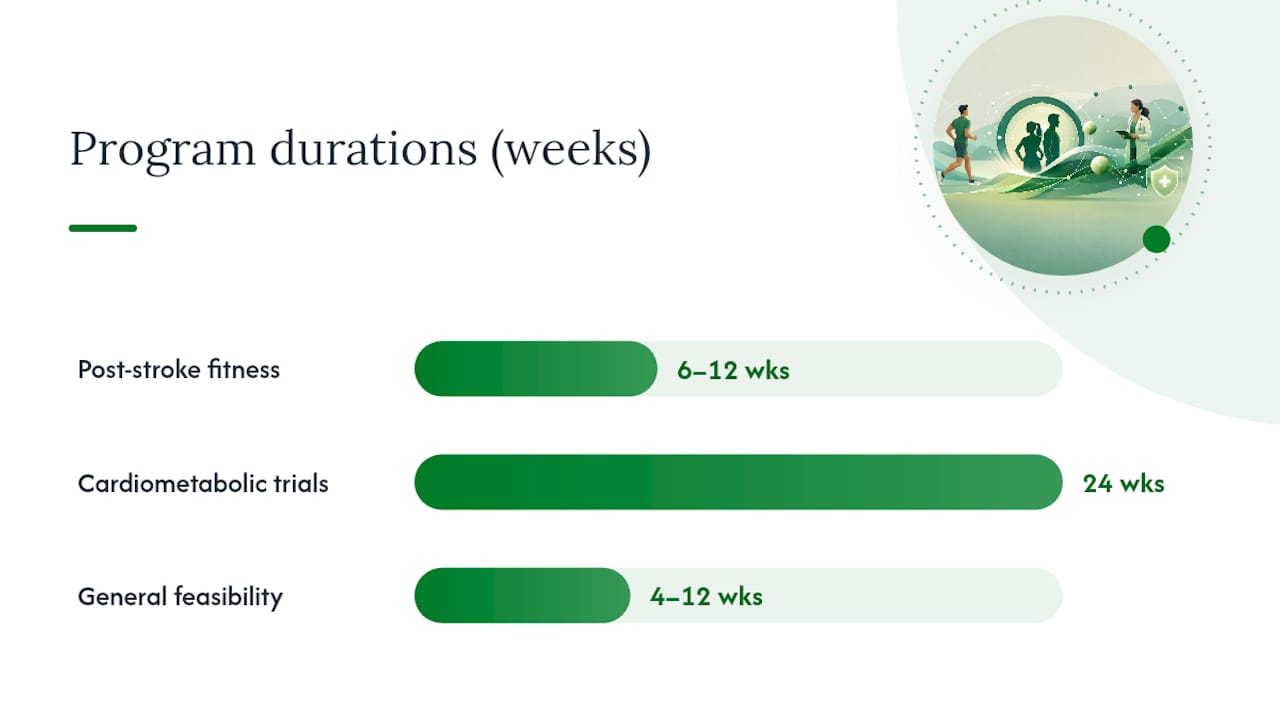
A feasibility study of a telehealth exercise program aimed at increasing cardiorespiratory fitness for people after stroke landed on a specific formula: three sessions per week, 20 to 30 minutes per session, run over 6 to 12 weeks. That’s a deliberately modest ask. Stroke survivors dealing with fatigue and motor deficits don’t respond well to hour-long sessions five days a week. Shorter, more frequent sessions kept people showing up.
Contrast that with cardiometabolic-focused trials aimed at a different population. The CHIME trial testing a telehealth exercise program for cardiometabolic health runs a live intervention over 24 weeks, nearly triple the stroke-rehab timeline. Adults managing blood pressure, blood sugar, or lipid issues need sustained behavior change to move biomarkers, and a six-week sprint simply doesn’t produce durable results for that goal.
Clinicaltrials confirm the field isn’t settled on one universal formula. Trial designs vary by population, outcome measure, and how aggressively researchers want to test adherence limits. That variation matters for you as a participant: the “right” telehealth workout schedule depends heavily on your starting condition and goal, not on some industry-wide standard duration.
Here’s how a few representative trial designs stack up:
| Program Focus | Population | Frequency | Session Length | Program Duration |
|---|---|---|---|---|
| Cardiorespiratory fitness after stroke | Stroke survivors | 3 sessions/week | 20–30 minutes | 6–12 weeks |
| Cardiometabolic risk reduction | Adults with cardiometabolic risk factors | Live weekly sessions | Varies by visit type | 24 weeks |
| General tele-exercise feasibility studies | Mixed adult populations | 2–4 sessions/week | 20 to 30 minutes | 4–12 weeks |
The instructor-led versus self-guided distinction shapes adherence more than almost any other variable. Live, coached sessions carry real-time accountability. Someone notices if you don’t show up, and someone corrects your squat depth before it becomes a knee problem. Self-guided, on-demand formats offer more flexibility but rely entirely on the participant’s own discipline, and dropout rates in unsupervised digital fitness programs tend to run higher once the novelty wears off around week three or four.
Pro Tip: If you’ve struggled to stick with home workout apps before, look specifically for a program with live check-ins, even biweekly ones, rather than a purely on-demand library. The accountability difference is the whole point of going the telehealth route instead of just buying a fitness app.
One data point worth internalizing: the stroke-rehab feasibility study’s preferred parameters of three 20 to 30 minute sessions weekly reflect a broader pattern across tele-exercise research: shorter, more frequent sessions consistently beat longer, sparser ones for adherence in medically supervised populations. If a program is pitching you on hour-plus sessions twice a week, that design runs against what the feasibility literature actually found works.
What the Research Shows on Safety and Results
Telehealth exercise programs aren’t experimental fringe science anymore. They’re producing measurable clinical outcomes, and the safety protocols around them have matured to match.
On the outcomes side, feasibility trials in stroke populations have documented real improvements in cardiorespiratory fitness when programs stick to structured, supervised parameters. Broader reviews of tele-exercise literature point to a growing body of published research across rehabilitation and cardiometabolic contexts, not just isolated pilot studies. The CHIME trial’s 24-week design specifically targets cardiometabolic markers like blood pressure and metabolic function, and longer-duration live programs like this one exist precisely because short interventions don’t move those numbers reliably.
Trial protocols for specific populations, including wheelchair users, show that tele-exercise can be adapted with modified movements and tailored supervision rather than forcing everyone through an identical protocol. That’s a meaningful finding: telehealth fitness isn’t one workout broadcast to everyone watching. It’s adjustable in ways that matter clinically.
None of that works without real safety infrastructure behind it. A legitimate telehealth fitness program should include:
- Pre-participation screening that asks about cardiac history, recent surgeries, medications, and known mobility limitations before your first session
- Medical clearance from a physician when you have an existing condition, particularly heart disease, uncontrolled hypertension, or recent orthopedic surgery
- Real-time monitoring during sessions, whether that’s a coach watching your heart rate response or a clinician observing your movement pattern live on camera
- A documented emergency plan, meaning your provider knows your location and has a protocol if something goes wrong mid-session
- Follow-up assessments at set intervals to confirm the program is still appropriate as your condition changes
Certain signs should send you toward in-person evaluation instead of a video session, no exceptions. Chest pain, unexplained shortness of breath at rest, new or worsening dizziness, and any sudden change in a chronic condition’s symptoms all warrant a phone call to a provider and possibly an in-person visit rather than logging on for a scheduled workout. A remote exercise program is not equipped to physically examine you, and a responsible provider will say so rather than pushing you through a session anyway.
Pro Tip: Ask any telehealth fitness provider directly what their emergency protocol is before you book your first session. A program that can’t answer clearly, or that doesn’t ask about your medical history at intake, is skipping a step the research-backed programs treat as non-negotiable.
Technology, Space, and Equipment You’ll Actually Need
You don’t need a home gym to start a telehealth fitness program, but you do need a few things working reliably before your first session.
On the technology side, a smartphone, tablet, or computer with a working camera and microphone covers the baseline requirement most programs list, echoing the prerequisites outlined in Rush’s virtual fitness telemedicine service. Internet speed matters more than device quality; aim for at least 2 to 5 Mbps upload speed so video doesn’t freeze mid-exercise, which is exactly when a coach needs to see you clearly to correct form. A charged device and a stable Wi-Fi connection, or a solid mobile hotspot as backup, round out the basics.
- Position your camera at a distance that shows your full body, not just your face, so your coach can actually see your form during squats, lunges, or balance exercises.
- Set up in a well-lit room, ideally with light coming from in front of you rather than behind, so movement details aren’t lost in shadow.
- Confirm privacy before medical-linked sessions. If your program is tied to a health record or involves discussing personal health information, check that the platform meets telehealth privacy standards. TWL’s consent-to-telehealth page walks through what that consent typically covers.
- Clear a space roughly 6 by 6 feet, enough to lunge, step, or lie down without hitting furniture.
- Gather minimal equipment: a set of resistance bands, one or two pairs of light dumbbells, and a sturdy chair for balance work or seated exercises cover the vast majority of home-based programs.
None of this requires a significant investment. Most people already own a phone that meets the technical bar, and $30 to $40 in resistance bands and light dumbbells covers the equipment gap for the majority of programs built around bodyweight and light resistance training.
Getting Started: What to Expect in the First 4 to 12 Weeks
Choosing the right program starts with a short checklist, because not every service marketed as “telehealth fitness” carries the same level of oversight.
Before signing up, confirm the program offers genuine medical supervision or at least a documented screening process, not just an intake form nobody reviews. Check the credentials of whoever will lead your sessions, physical therapist, exercise physiologist, or certified trainer working under clinical guidance. Ask whether the program sets measurable goals and tracks them over time rather than just running you through generic workouts. Confirm the platform handles health data securely. And ask what happens after week one, specifically whether there’s a defined progression plan or if you’re expected to freelance your own advancement.
The intake process itself typically follows a predictable sequence:
- Screening form, covering medical history, current medications, injury history, and activity level
- Baseline assessment, which might be a fitness test, a functional movement screen, or a simple walk test depending on your goals and limitations
- Personalized plan development, where a provider translates your baseline into a specific frequency, session length, and progression schedule
- Scheduled sessions begin, usually starting conservatively to gauge your response before increasing load or duration
- Follow-up and adjustment, typically every 2 to 4 weeks, to reassess and modify the plan based on progress
Realistically, weeks one and two are about establishing a routine and confirming the platform, schedule, and coach are a good fit. Don’t expect dramatic changes yet; expect to notice whether you’re actually showing up. By weeks three and four, most people report better tolerance of the sessions themselves, meaning the same workout that felt hard on day one feels more manageable. Weeks five through eight are typically where measurable changes start appearing: better endurance during sessions, small strength gains, or early movement toward biomarker goals if you’re tracking blood pressure or glucose. Weeks nine through twelve often bring a formal reassessment, comparing your baseline numbers to current ones and adjusting the plan for the next phase.
Pro Tip: Track one simple metric weekly, resting heart rate, minutes of continuous activity, or perceived effort on a 1 to 10 scale, so you have concrete evidence of progress even before a formal 12 week reassessment. Adherence tends to improve when people can see small wins in real numbers.
Why Integrated Telehealth Care Improves Outcomes
The biggest gap in most standalone fitness programs, telehealth or otherwise, is that they operate in isolation from the rest of your health care. A coach who doesn’t know about your blood pressure medication, your recent labs, or your mental health status is working with one hand tied behind their back.
Integrated telehealth platforms close that gap by design. When medication management, primary care, mental health support, and fitness coaching live under one system, your exercise plan can actually account for what else is happening in your care. That matters most for people combining fitness with medically supervised weight loss. Anyone using a GLP-1 medication for weight loss needs resistance training built explicitly into their routine to help preserve lean muscle mass during rapid fat loss, a detail that a generic fitness app has no way of knowing to flag.
Top Weight Loss Med structures its platform around exactly this kind of coordination. Same-day appointment booking means you’re not waiting weeks to get screened before starting a program. Medication delivery integration means your weight-loss prescription and your fitness coaching aren’t handled by two disconnected systems that never talk to each other. And because primary care, mental health, and fitness fall under the same platform, a provider adjusting your exercise plan can see the full picture rather than guessing.
For adults over 40 in particular, this integration tends to matter more, not less. Successful long-term programs at that age generally need to account for medication interactions, hormonal shifts, and recovery capacity that changes with age, all of which are easier to manage when one coordinated team is watching the whole picture rather than a fitness coach working with zero visibility into your medical chart. Explore how a coordinated approach to weight loss and coaching accounts for these overlapping needs rather than treating fitness as a separate problem from everything else going on in your health.
How Your Privacy Is Protected in a Remote Fitness Program
Telehealth fitness programs that involve any medical oversight are handling protected health information, which means the same privacy standards that apply to your doctor’s office apply here too. Video visits, care plans, and any health data shared during intake should be encrypted and stored on platforms built to meet those standards, not routed through a generic video conferencing app with no health data protections.
Before enrolling, check whether the platform requires a documented consent process. A program’s consent-to-telehealth materials should spell out exactly what data gets collected, who can access it, and how session recordings, if any exist, are stored and eventually deleted. If a coach or clinician plans to reference your health history during sessions, that information should live inside the same protected system, not in a separate spreadsheet or unsecured chat log.

Ask specifically whether video sessions are recorded, and if so, for how long and for what purpose. Some programs record briefly for quality review and then delete footage; others retain nothing at all. Neither approach is inherently wrong, but you deserve a straight answer before your first session, not a vague policy buried in fine print you never read.
Getting a Program That Actually Fits You
Generic workout plans fail for a predictable reason: they ignore the fact that your starting fitness, injury history, medications, and goals are different from the next person’s. A telehealth fitness program worth paying for should build its plan around your baseline assessment results, not hand you the same 8-week template everyone else gets.
Real customization shows up in a few specific ways. Session intensity should scale to your baseline fitness test rather than assuming everyone starts at the same level. Exercise selection should account for any injury history or mobility limitation flagged during intake, swapping a lunge for a supported step-up if your knees can’t tolerate it. Progression pace should adjust based on how you’re actually responding, not a fixed calendar that increases load every two weeks regardless of your recovery.
For people managing a chronic condition alongside their fitness goals, personalization needs to go further still. Someone managing blood pressure needs a different intensity ceiling than someone training purely for general conditioning. Someone combining a weight-loss medication with exercise needs resistance training specifically preserved in the plan to protect lean mass, not just general cardio thrown in as an afterthought.
The best sign of genuine personalization is a plan that changes over time based on your actual data, follow-up assessments, session feedback, and biomarker shifts, rather than a static plan you’re handed once and never revisited.
Where Telehealth Fitness Programs Tend to Break Down
Most participants who quit a telehealth fitness program don’t quit because the exercise itself was too hard. They quit for a handful of predictable, fixable reasons.
Technical friction tops the list. A frozen video call or a laggy connection during a session is frustrating enough to make people skip the next one. The fix is boring but effective: test your connection before your first session, not during it, and keep a backup device or hotspot ready.
Motivation dips around week three or four are almost universal, especially in self-guided or on-demand formats without live accountability. Programs with scheduled live check-ins, even biweekly ones, consistently see better follow-through than purely on-demand libraries, which is worth weighing heavily when you’re choosing a program in the first place.
Feeling disconnected from a coach who’s only a face on a screen is a real barrier for some people, particularly those used to in-person gym relationships. Programs that build in regular two-way check-ins, not just one-directional instruction, tend to close that gap better than pure video-broadcast formats.
Finally, plateau frustration hits when a program never reassesses or adjusts. If your plan looks identical in week eight as it did in week two, that’s not a personalization issue, that’s a program design failure, and it’s worth raising directly with your provider or considering a switch.
Does Insurance Cover a Telehealth Fitness Program?
Coverage varies significantly depending on how the program is structured and billed. Telehealth visits tied to a documented medical need, physical therapy following surgery, cardiac rehabilitation, or a physician-supervised exercise plan tied to a diagnosed condition, are far more likely to see insurance reimbursement than a general wellness coaching subscription with no medical diagnosis attached.
Programs delivered through licensed clinicians, physical therapists, or physicians as part of a documented care plan typically bill using the same telehealth codes insurers already recognize for other virtual visits. General fitness coaching without a clinical tie-in, by contrast, usually falls outside standard insurance coverage and gets treated as an out-of-pocket wellness expense.
Platforms that integrate primary care with fitness coaching have an advantage here, since visits tied to primary care or chronic disease management can sometimes qualify for coverage even when the fitness component itself wouldn’t independently. Before enrolling, ask your provider directly whether your specific plan bills through insurance or operates as a self-pay service, and confirm with your insurance company what your specific plan covers for telehealth visits tied to your diagnosis. Reviewing a weight loss FAQ resource can also clarify how coverage typically works for programs that combine medical weight-loss treatment with coaching support.
When Telehealth Fitness Makes Sense, and When It Doesn’t
Telehealth fitness earns its place when the alternative is nothing at all. If distance, mobility limitations, or a packed schedule mean the choice is between a video session and skipping exercise entirely, the video session wins every time, especially when a real clinician or trained coach is watching and adjusting in real time. The evidence backing shorter, structured programs for populations like stroke survivors isn’t marginal. It’s a genuine, replicable finding across feasibility research.
Where I’d push back on the enthusiasm around remote fitness is the assumption that it works equally well for everyone, regardless of condition severity. A camera can’t palpate a swollen joint, can’t take your blood pressure mid-session unless you own a cuff, and can’t catch subtle changes in gait the way an in-person physical therapist can from three feet away. Anyone with unstable cardiac symptoms, recent major surgery requiring hands-on rehab assessment, or a condition that’s actively changing week to week needs in-person evaluation at some point in the process, even if ongoing maintenance later shifts to video.
My practical recommendation for screening candidates: don’t ask “is this person capable of exercising,” ask “does this person’s condition require hands-on physical assessment right now.” If the answer is no, and most stable, chronic-condition cases fall into that category, a well-designed telehealth fitness program with real medical oversight is not a compromise. It’s often the more consistent, more monitored option compared to sporadic in-person visits squeezed between work and family obligations. If the answer is yes, telehealth should supplement in-person care, not replace it.
— Bryan
How Top Weight Loss Med Puts Telehealth Fitness Into Practice
Choosing between a standalone fitness app and a program with zero clinical backing is the wrong choice to have to make in the first place. Top Weight Loss Med solves that by putting fitness coaching, medication management, and primary care under a single telehealth login, so your exercise plan is built with visibility into the rest of your health picture, not guessed at from scratch.
Appointment booking is designed to enable screening and starting a program more quickly than typical specialist referral wait times. If you’re managing weight loss alongside a prescription treatment, your provider can build resistance training into your plan specifically to protect lean muscle mass during rapid fat loss, coordinating that guidance with your medication plan rather than treating fitness as a separate, disconnected service. Insurance partnerships aim to help make the program more affordable compared to arranging separate personal training, nutrition, and telehealth services independently.
If you’re ready to see whether a coordinated program fits your situation, check your eligibility for a weight-loss program and get matched with a provider who can build your plan around your actual health history, not a generic template.
Further Reading and Primary Sources
The stroke rehabilitation feasibility study provides the clearest published data on preferred frequency, session length, and program duration for supervised telehealth exercise. The CHIME trial listing demonstrates how longer-duration, live programs are structured for cardiometabolic risk populations. Rush University Medical Center’s virtual fitness telemedicine page shows what a real hospital-run program’s patient flow looks like in practice. The ClinicalTrials.gov registry entry confirms that trial designs in this field remain active and varied rather than settled on one fixed model.
This article is general information, not a substitute for advice from a qualified doctor. Consult a qualified healthcare professional about your own circumstances before acting on anything here.
Sources
- The Feasibility of a Telehealth Exercise Program Aimed at Increasing Cardiorespiratory Fitness for People After Stroke
- Fitness and Sports Performance Telemedicine
- Clinicaltrials
FAQ
What is the best online fitness program?
There’s no single best program for everyone; it depends on whether you need medical supervision, general conditioning, or rehab-specific support. For people managing a health condition or combining fitness with medical weight loss, a telehealth fitness program with real clinical oversight, like the coordinated coaching offered through Top Weight Loss Med, tends to outperform a generic workout app.
Can I do physical therapy through telehealth?
Yes, many physical therapy practices and hospital telemedicine programs now offer live video sessions for assessment, exercise instruction, and progress tracking. Telehealth physical therapy works best for follow-up care and home exercise supervision, though some conditions still require periodic in-person evaluation.
Does Netflix have an exercise program?
No, Netflix does not offer a structured exercise or fitness coaching program; it’s a streaming entertainment platform, not a telehealth or fitness service.
Does Amazon Prime have free workouts?
Amazon does not include a dedicated fitness coaching program as a standard Prime benefit, though some fitness content may appear through Prime Video’s on-demand library. This differs fundamentally from a telehealth fitness program, which involves clinical screening, personalized planning, and live or monitored coaching rather than passive video content.
How many sessions per week does a telehealth fitness program typically involve?
Feasibility research on post-stroke telehealth exercise found three sessions per week, at 20 to 30 minutes each, worked best for adherence, though cardiometabolic-focused programs like the CHIME trial run longer overall durations of up to 24 weeks.
Is a telehealth fitness program covered by insurance?
Coverage depends on whether the program is billed as a clinical service tied to a diagnosis, such as physical therapy or physician-supervised exercise, versus a general wellness subscription. Programs integrated with primary care or medical weight-loss treatment have a better chance of insurance reimbursement than standalone fitness coaching.