TL;DR:
- The cost of semaglutide in the U.S. ranges from $25 per month with insurance and savings programs to over $1,000 without discounts. Activating savings cards and choosing bundled telehealth plans can significantly reduce out-of-pocket expenses for eligible patients. Regulatory changes in 2026 have tightened restrictions on compounded semaglutide, impacting availability and legality.
Semaglutide cost in the U.S. runs anywhere from $25 per month with qualifying commercial insurance and a manufacturer savings card to more than $1,000 per month at retail list price without any discounts. The two fastest levers are to activate the Novo Nordisk manufacturer savings card if you have commercial insurance, or to use a bundled telehealth plan with transparent flat-rate pricing if you’re uninsured or your plan excludes weight-loss drugs.
Here’s the realistic range at a glance:
- A low monthly cost for commercially insured patients using the Wegovy or Ozempic savings card who meet eligibility criteria
- Moderate monthly costs for bundled telehealth or NovoCare self-pay introductory tiers (first 1–2 fills)
- Variable cost range for compounded semaglutide through licensed pharmacies (availability narrowed in 2026)
- Higher brand-name retail list price without insurance or savings programs
Which path fits you? Insured with formulary coverage: check savings card eligibility first. Insured but your plan excludes weight loss: look at NovoCare self-pay or a telehealth flat plan. Medicare Part D: the Medicare GLP-1 Bridge offers $50/month for eligible members. Uninsured or self-pay: a bundled telehealth program that folds in labs and visits is usually the most predictable total cost.
How insurance determines what you pay for semaglutide
Coverage depends on two things above all else: your plan’s formulary and the indication on your prescription. Many commercial plans cover Ozempic for type 2 diabetes but exclude Wegovy for weight management entirely. That single distinction can be the difference between a $25 copay and a $1,350 out-of-pocket bill.
Before you call your insurer, know what to ask:
- Is semaglutide (Wegovy or Ozempic) on my formulary, and at what tier?
- Does my plan cover GLP-1s for weight management, or only for type 2 diabetes?
- Is prior authorization required, and what clinical criteria must I meet?
- Is step therapy required (trying another drug first before semaglutide is approved)?
- Are there quantity limits per fill or per year?
- Must I use a specialty pharmacy, or can I fill at any in-network retail pharmacy?
- What is my copay or coinsurance structure after deductible?
Understanding how a diabetic supply formulary works can help you decode the same logic that governs GLP-1 coverage decisions.
Medicare and Medicaid rules are different. Traditional Medicare Part D has historically excluded weight-loss drugs, though the Medicare GLP-1 Bridge program offers $50/month for eligible Part D members from July 1, 2026 through December 31, 2027. Medicare beneficiaries cannot use manufacturer commercial savings cards. Medicaid coverage varies by state. CMS has also selected additional drugs for Medicare price negotiations, signaling continued federal attention to GLP-1 pricing.
Out-of-pocket examples by plan type:
- Commercial plan with formulary coverage + savings card: As low as $25/month
- Commercial plan that excludes weight-loss drugs: $900–$1,350/month at retail, or $200–$500/month via NovoCare self-pay
- Medicare Part D (Bridge-eligible): $50/month during the Bridge window (July 2026–December 2027)
- Uninsured/self-pay: $200–$500/month on introductory telehealth tiers; steps up at maintenance dose
Concrete ways to lower your semaglutide bill
The savings options aren’t equally available to everyone. Here’s what works, who it works for, and what to watch out for.
1. Manufacturer savings cards (Novo Nordisk) The Ozempic and Wegovy savings programs can reduce cost to $25/month for commercially insured patients who meet eligibility criteria. You must have commercial insurance that covers the drug; government plan members (Medicare, Medicaid, TRICARE, VA) are excluded. Apply directly on the Novo Nordisk product websites.
2. NovoCare self-pay pricing Novo Nordisk’s NovoCare program offers tiered self-pay pricing for uninsured patients or those whose insurance doesn’t cover semaglutide. Introductory pricing applies to the first one or two fills, then steps up. Check the current NovoCare tier schedule before assuming the intro price is what you’ll pay long-term.
3. GoodRx and retail discount cards GoodRx and similar discount programs can reduce out-of-pocket cost at retail pharmacies, though savings on brand-name GLP-1s are typically modest compared to the manufacturer savings card. Most useful when you don’t qualify for the savings card or need a one-time fill.
4. Bundled telehealth plans Some telehealth programs bundle the provider consultation, labs, and medication into a single flat monthly rate. This is often the most predictable option for self-pay patients because it eliminates surprise billing for visits and monitoring. GLP-1 telehealth programs vary widely in what’s included, so confirm the full scope in writing.
5. Patient assistance programs Novo Nordisk’s patient assistance program (NovoCare Patient Assistance) provides free medication to qualifying low-income patients who meet income and insurance thresholds. Applications require income documentation and a provider signature.
6. HSA and FSA accounts Semaglutide prescribed for a qualifying medical condition (type 2 diabetes or obesity) is generally HSA/FSA-eligible. Using pre-tax dollars effectively reduces your real cost by your marginal tax rate.
7. Medicare GLP-1 Bridge For eligible Part D members, the Bridge program caps cost at $50/month through December 2027. Confirm eligibility with your Part D plan directly.
Example cost scenarios:
- Commercially insured, savings card eligible: List price ~$1,350 → savings card → $25/month
- Medicare Part D, Bridge-eligible: Standard Part D cost → Bridge program → $50/month
- Uninsured, telehealth flat plan: Bundled consultation + medication → $200–$400/month (introductory; confirm maintenance pricing)
Pro Tip: When a telehealth plan folds labs and provider visits into a flat monthly rate, your total cost is often lower than paying for medication alone at retail and then getting billed separately for quarterly labs and check-ins. Do the math on the full annual cost, not just the monthly drug price.
Compounded semaglutide: cheaper, but with real tradeoffs
Compounded semaglutide attracted significant attention in 2024 and 2025 when brand-name supply was constrained and prices were high. The appeal was straightforward: compounding pharmacies offered semaglutide at a fraction of the brand-name list price. The regulatory picture changed materially in 2026.
The FDA clarified its compounding policies as GLP-1 supply began to stabilize, narrowing the conditions under which compounding pharmacies can legally produce copies of commercially available drugs. 503A pharmacies (patient-specific compounders) and 503B outsourcing facilities (larger-scale compounders) operate under different rules, and both face tighter scrutiny now that shortage designations have been lifted for most semaglutide products. Clinicians report that compounded semaglutide options became less reliable after these 2026 policy clarifications, and provider verification is now more important than ever.
Red flags include providers who offer compounded semaglutide without a clinical consultation, no documentation of pharmacy accreditation, and prices that seem implausibly low even compared to other compounders.
Where to get a semaglutide prescription and how the channel affects cost
You don’t need an in-person visit to get a semaglutide prescription in most states, but where you get it and where you fill it both affect your total cost.
- Primary care provider + retail pharmacy: Most familiar path. Your PCP handles the prescription and PA paperwork; you fill at a local or mail-order pharmacy. Lab fees and visit copays are billed separately. Good option if your insurance covers the drug and your PCP is experienced with GLP-1 prior authorizations.
- Telehealth programs with bundled pricing: A provider consults with you online, writes the prescription, and coordinates pharmacy delivery. The best programs include labs and follow-up visits in a flat monthly rate. Convenient and often the most cost-transparent option for self-pay patients. See how GLP-1 safety monitoring fits into a bundled program before enrolling.
- Specialty pharmacies: Required by some insurers for GLP-1s. They often have dedicated prior authorization teams, which can speed up coverage approval. Cost at specialty pharmacies varies; confirm your copay before the first fill.
- Clinic-dispensed models: Some weight-loss clinics dispense medication directly. Convenient, but verify whether the clinic price includes the drug, the visit, and labs, or whether those are separate line items.
Pro Tip: Ask any provider upfront: “Will you handle prior authorization paperwork, and is that included in your fee?” Some telehealth programs include PA support; others charge separately or leave it entirely to the patient.
Prescribing rules vary by state, and compounding restrictions now apply in most jurisdictions following the 2026 FDA guidance. Channels that are transparent about total cost, including labs and visits, tend to produce fewer billing surprises over a full year of treatment.
How prices in this guide were estimated
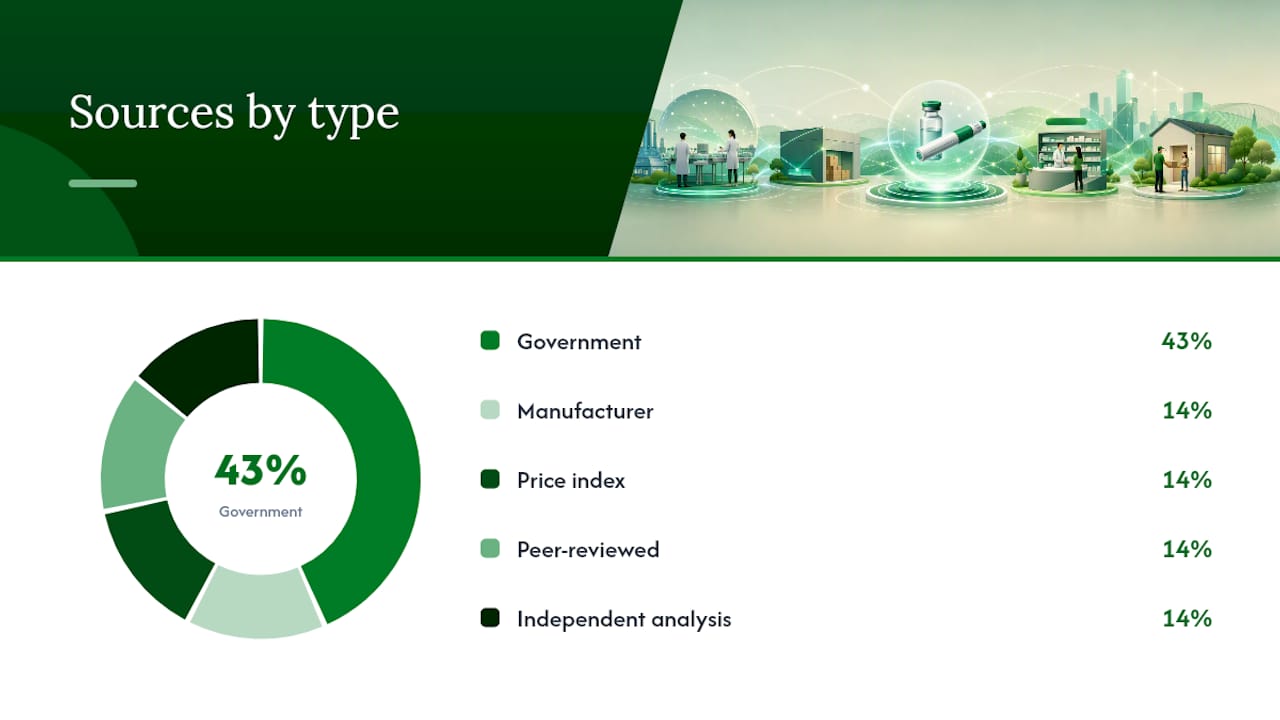
The price examples throughout this article draw on a consistent set of public sources, applied with specific rules to translate list prices into realistic out-of-pocket ranges.
| Source Type | Source | How It Was Used |
|---|---|---|
| Manufacturer | Novo Nordisk product pages (Ozempic, Wegovy, Rybelsus) | List prices and savings card eligibility rules |
| Government (FDA) | FDA product labels (AccessData) | Dose strengths, approved indications, dispensing units |
| Government (CMS) | CMS press releases on drug price negotiations | Medicare policy context and Bridge program details |
| Government (VA) | VA clinical formulary update for Wegovy | Formulary-based coverage criteria in integrated systems |
| Price index | GLP-1 Price Index (GLP-1 Answers) | Channel-by-channel price comparisons and Medicare Bridge details |
| Peer-reviewed | PMC / NCBI GLP-1 clinical outcomes | Clinical context and value-versus-cost commentary |
| Independent analysis | Samueli Institute semaglutide cost analysis | Real-world OOP ranges and telehealth bundle math |
- All prices are in USD and reflect publicly available data as of mid-2026
- Self-pay introductory prices are time-limited and typically step up after the first one or two fills
- List prices are manufacturer-published wholesale acquisition costs; actual retail prices vary by pharmacy and negotiated rates
- Out-of-pocket examples assume standard commercial insurance structures; individual plan terms vary
Key Takeaways
Brand-name semaglutide list prices exceed $1,000/month and can reach $1,350/month at retail, but commercially insured patients using a manufacturer savings card can pay as little as $25/month, making the savings card the single most impactful lever for eligible patients.
| Point | Details |
|---|---|
| Wide price range | Semaglutide cost varies significantly depending on insurance and savings eligibility. |
| Indication drives coverage | Plans that cover Ozempic for diabetes often deny Wegovy for weight loss; confirm your specific indication before assuming coverage. |
| Medicare Bridge available | Eligible Part D members can access semaglutide at reduced cost through the Medicare GLP-1 Bridge program during a specified period. |
| Compounding risk increased | FDA policy changes in 2026 narrowed legal compounding eligibility; verify any compounder’s 503A/503B status and testing documentation. |
| Topweightlossmed option | Topweightlossmed offers bundled telehealth weight-loss programs with insurance integration and transparent flat-rate pricing, reducing surprise billing. |
The real cost problem isn’t the drug price
The conversation about semaglutide affordability tends to fixate on the list price, which is understandable when the number is $1,350. But the list price is almost never what patients actually pay, and focusing on it can push people toward decisions that look cheaper on paper but cost more in practice.
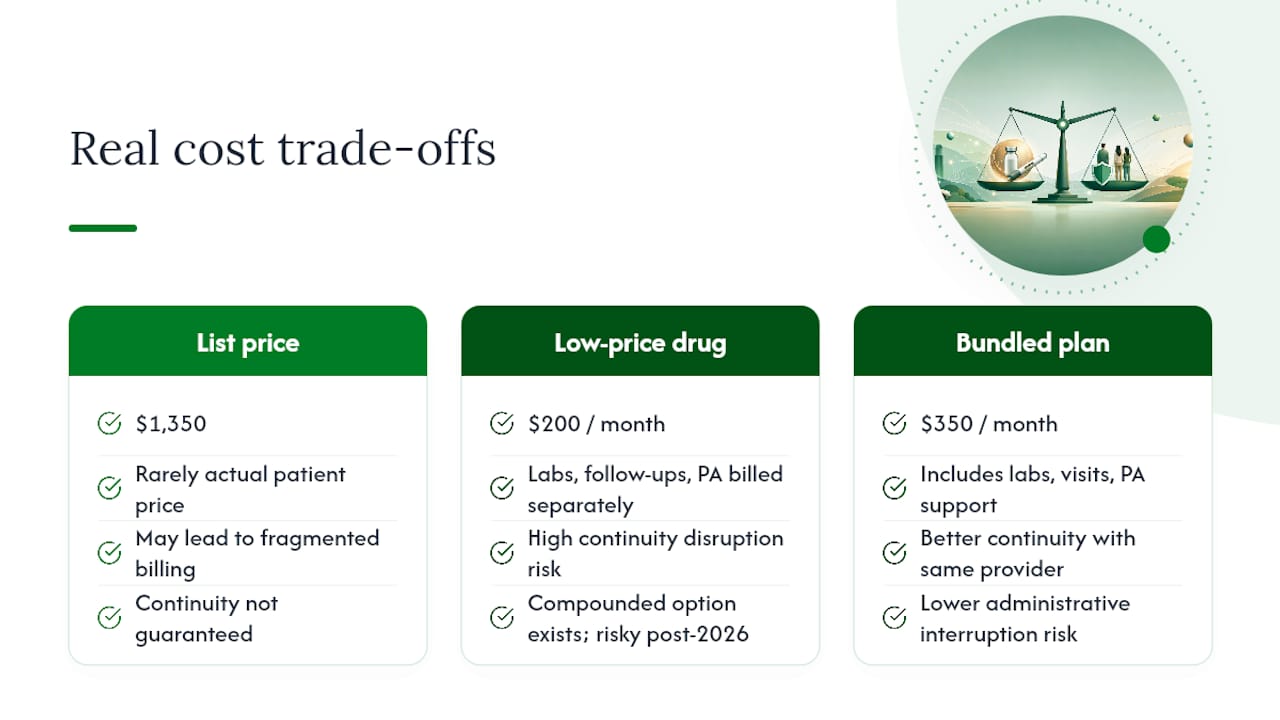
The more common trap is fragmented billing. A patient finds a telehealth provider offering semaglutide at a seemingly reasonable monthly rate, starts treatment, and then discovers that quarterly labs, follow-up visits, and prior authorization support are all billed separately. By month six, the real cost is significantly higher than the headline number suggested. A bundled plan at $350/month that includes everything is often a better deal than a $200/month drug price with $500/year in unbundled services on top.
The other underappreciated issue is continuity. Switching providers mid-treatment to chase a lower price can mean restarting prior authorization, losing dose escalation history, and disrupting the monitoring that makes GLP-1 therapy safe. The cheapest first month is not the right metric. The right metric is the total cost of a full year of treatment, including labs, visits, and any PA support, from a provider who will still be there at month twelve.
Compounded semaglutide is a real option for some patients, but the 2026 regulatory changes made it a higher-stakes choice. The question isn’t just whether it’s cheaper today; it’s whether the source is verifiable, the product is tested, and the provider will be legally able to continue supplying it in six months.
Useful sources
The following sources were used to verify pricing, regulatory status, and coverage rules cited in this guide:
- Semaglutide Cost in 2026: Every Real Price Compared
- FDA clarifies policies for compounders as national GLP-1 supply begins to stabilize
- Ozempic® Cost & Coverage | Ozempic® savings and resources
- GLP-1 Price Index | GLP-1 Answers
- HHS announces additional drugs selected for Medicare drug price negotiations | CMS
- WEGOVY for weight management clinical formulary update | VA
- Peer-reviewed article on GLP-1 clinical outcomes | PMC
- Semaglutide cost per month — SingleCare
- FDA label (2026) — semaglutide product label
FAQ
Are semaglutide pills cheaper than injections?
Rybelsus (oral semaglutide) carries a list price slightly below Wegovy’s ~$1,350/month but comparable to Ozempic, typically ranging between $900 and $1,000 per month. The oral form is approved only for type 2 diabetes, so weight-management patients typically can’t access it through insurance for that indication.
How can I afford semaglutide for weight loss?
The fastest path is activating the Novo Nordisk savings card if you have qualifying commercial insurance, which can reduce cost to $25/month. Uninsured patients should compare bundled telehealth flat-rate plans, which fold in labs and visits, against NovoCare self-pay tiers.
How much semaglutide is in one Ozempic pen?
Ozempic pens come in 0.5 mg, 1 mg, and 2 mg dose strengths per injection; each pen contains enough medication for multiple weekly doses depending on the prescribed strength. FDA labeling specifies the exact fill volume and dose units for each pen configuration.
What happens if you stop taking semaglutide?
Most patients regain a significant portion of lost weight after stopping GLP-1 therapy, as the drug’s appetite-suppressing effects are not permanent. This is a key reason continuity of care and a stable, affordable supply matter as much as the initial cost.
Does Medicare cover semaglutide for weight loss?
Traditional Medicare Part D has historically excluded weight-loss drugs, but the Medicare GLP-1 Bridge program provides $50/month access for eligible Part D members from July 1, 2026 through December 31, 2027. Medicare beneficiaries cannot use Novo Nordisk’s commercial savings cards.