Most adults on GLP-1 medications should aim for approximately 1.2 to 1.6 grams of protein per kilogram of lean body mass daily, and the single biggest lever for protecting muscle is pairing that protein with resistance training. Put your largest protein serving at whatever meal your appetite tolerates best. Individualize this range with your prescribing clinician, especially if you’re older, managing kidney disease, or new to strength training.
TL;DR:
- Most adults on GLP-1 medications should aim for 1.2 to 1.6 grams of protein per kilogram of lean body mass daily, with older adults leaning toward the higher end.
- Consuming at least 25 to 30 grams of high-quality animal protein per meal is needed to trigger muscle protein synthesis and prevent muscle loss.
- Practical food sources like Greek yogurt, chicken, eggs, and lentils can help meet protein targets without excessive effort, especially when appetite is limited.
- Resistance training two to four times weekly is essential to signal muscle preservation, with progressive overload to enhance muscle strength and function.
- People with specific conditions like chronic kidney disease or persistent nausea should seek individualized guidance to adjust protein intake appropriately.
Table of Contents
- Daily Protein Targets While on GLP-1s and How to Calculate Yours
- How Many Grams of Protein Per Meal Actually Build Muscle?
- Best Protein Sources and Portion Sizes to Hit Your Target
- What to Do When Appetite Is Too Low to Eat Enough Protein
- Why Resistance Training Matters as Much as Protein Intake
- Who Needs to Adjust These Protein Targets?
- How to Track Progress and Know When to Call a Professional
- What I’d Tell a Patient Starting Today
- Get Clinician-Backed Support for GLP-1 Weight Loss
- Sources
- FAQ
Daily Protein Targets While on GLP-1s and How to Calculate Yours
The standard dietary reference intake for protein is about 0.8 grams per kilogram of body weight, designed to prevent deficiency in a sedentary adult eating maintenance calories. This figure does not specifically address individuals losing weight rapidly on a GLP-1 drug. When you’re in a calorie deficit, your body starts breaking down muscle tissue for fuel alongside fat, and low protein intake accelerates that loss.
Clinical-nutrition frameworks built specifically for GLP-1 therapy commonly recommend starting around 1.2 to 1.6 grams per kilogram of body weight per day](https://glp1nutrition.org/protein/protein-targets-on-glp-1/), nearly double the RDA. Older adults often need the higher end of that range or slightly above it, since aging muscle responds more sluggishly to protein signals, a phenomenon researchers call anabolic resistance.
Here’s the math in practice. Take your weight in pounds, divide by 2.2 to get kilograms, then multiply by your target number:
- As an example, converting body weight from pounds to kilograms and multiplying by a target protein per kilogram estimate yields daily protein targets. These serve as starting points for individualization.
Treat these as starting points, not fixed rules. Real-world tracking data suggests many people on GLP-1s actually eat closer to 0.6 grams per kilogram, less than half the practical target. Closing that gap matters more than chasing precision to the exact gram.
How Many Grams of Protein Per Meal Actually Build Muscle?
Your body doesn’t bank protein for later use the way it stores fat. Muscle protein synthesis, the process that repairs and builds muscle tissue, gets triggered meal by meal, and each trigger requires enough leucine (an amino acid found concentrated in animal protein) to cross a threshold.
That threshold works out to about 25 to 30 grams of high-quality animal protein per meal, or 35 to 45 grams if you’re relying mainly on plant proteins, since plant sources generally carry less leucine per gram. Below that amount, you still get some benefit, but you leave muscle-building potential on the table.
- Younger, active adults: 25 to 30 g per meal from animal sources is usually enough to hit the threshold.
- Adults over 60 or anyone with reduced muscle mass: aim for 30 to 40 g per meal to overcome anabolic resistance.
- Plant-forward eaters: combine sources (legumes plus grains, or a soy-based protein) and lean toward the higher end, 35 to 45 g.
Mayo Clinic nutrition guidance points to 20 to 30 grams per meal as a practical, achievable target for people managing a suppressed appetite on GLP-1 therapy, which lines up closely with the leucine threshold research.
Pro Tip: *If your appetite is strongest in the morning, front-load your biggest protein serving at breakfast.
Best Protein Sources and Portion Sizes to Hit Your Target
You don’t need a kitchen scale obsession to hit these numbers. A handful of everyday foods do most of the work, and knowing their approximate protein content lets you build meals on the fly.
- 1 cup Greek yogurt: about 20 to 22 g
- 3 oz cooked chicken breast: about 25 to 26 g
- 1 large egg: about 6 g (a three-egg omelet gets you to 18 g before you add cheese)
- 1 cup cooked lentils: about 15 to 18 g
- 3 oz canned tuna: roughly 20 g
- 1 cup cottage cheese: roughly 24 to 28 g
- 4 oz firm tofu or tempeh: roughly 10 to 15 g
These portion estimates track with the figures Mayo Clinic cites for patients managing appetite suppression on GLP-1 medications.
Protein-to-calorie efficiency matters more than people realize once appetite drops. If you can only physically eat 1,200 to 1,400 calories a day, every calorie needs to work harder. Lean choices like white fish, chicken breast, and low-fat Greek yogurt pack more protein per calorie than fattier cuts or processed protein snacks, which makes them the more efficient pick when your stomach fills up fast.
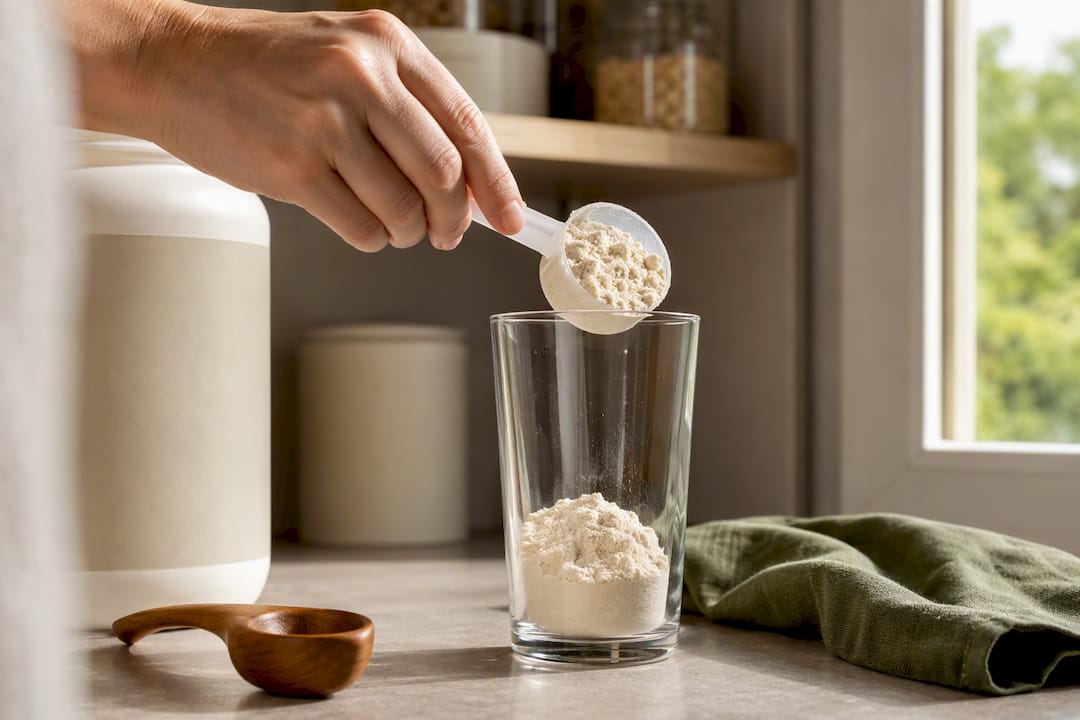
Protein powders and ready-to-drink shakes earn their place here too, particularly on days when solid food feels unappealing. Pick isolates over blends if you’re sensitive to lactose, and read labels for sugar alcohols like erythritol or mannitol. They’re common in “low-carb” protein products and can trigger bloating or GI discomfort, which is the last thing you need on top of GLP-1-related nausea. A recipe resource like Dinner Roulette Pro’s high-protein dinner ideas can help you build fast, protein-forward meals for nights when cooking feels like too much.

What to Do When Appetite Is Too Low to Eat Enough Protein
GLP-1 medications slow gastric emptying, which is exactly why they curb appetite. It’s also why hitting 90 to 130 grams of protein a day can feel physically impossible on a hard day. A few tactical shifts make a real difference.
- Eat protein first, sides second. Put the chicken, eggs, or fish on your fork before the rice or vegetables. If you fill up halfway through the meal, you’ve already banked your protein.
- Split intake into smaller, more frequent servings. Five small protein-containing snacks often beat three large meals when your stomach empties slowly.
- Keep a liquid backup ready. A 20 to 40 gram protein shake takes far less digestive effort than solid food and can rescue a day when nothing else sounds appetizing.
- Separate fluids from meals. Drinking a full glass of water right before eating leaves less room for food, so sip between meals instead of during them.
- Choose easier-to-digest proteins on rough days. Greek yogurt, fish, and protein smoothies tend to sit better than red meat when GLP-1-related nausea flares.
Dietitians working with GLP-1 patients report that nausea often drives people to avoid protein specifically, which is counterproductive since protein and fiber are the two nutrients most likely to protect against the GI issues you’re trying to dodge in the first place.
Pro Tip: Keep a lactose-free whey isolate or a plant-based blend in your pantry at all times. The day you can’t face a full meal is not the day you want to be reading labels at the grocery store.
Why Resistance Training Matters as Much as Protein Intake
Protein alone won’t protect your muscle. Without a mechanical signal telling your body why it needs that muscle, extra protein gets used for energy or stored as fat rather than preserved as lean tissue. Resistance training provides that signal, and clinical-nutrition reviews consistently point to it as one of two modifiable inputs, alongside protein intake, that best protect lean mass during rapid weight loss.
- Aim for 2 to 4 resistance sessions per week, hitting the major muscle groups (legs, back, chest, shoulders, core).
- Apply progressive overload: add small amounts of weight, reps, or sets over time rather than repeating the same routine indefinitely.
- Bodyweight exercises count if you’re new to training. Squats, push-ups, and rows all build the same protective stimulus as a gym setup.
Skip the daily scale obsession for judging whether your plan is working. Track strength trends (can you lift what you could a month ago?), functional markers (climbing stairs, carrying groceries), and, if accessible, periodic body-composition scans like DXA or bioimpedance every few months. A clinician-backed six-week strength plan built specifically for people on GLP-1 therapy gives you a structured starting point if you’re not sure where to begin.
Who Needs to Adjust These Protein Targets?
Standard protein targets don’t apply evenly to everyone, and a few groups need real modification rather than a rough estimate.
- Older adults: Anabolic resistance means muscle responds less efficiently to protein per gram, so targets often shift toward the higher end of the range with closer monitoring for early signs of sarcopenia, or age-related muscle loss.
- Chronic kidney disease: These general targets do not apply. Protein needs in CKD require an individualized prescription from a nephrologist, since excess protein can accelerate kidney decline in this population.
- Significant GI side effects: Temporary reductions in solid protein intake, shifted toward liquid sources, are reasonable while nausea resolves, but persistent inability to eat warrants a call to your prescribing clinician.
One data point worth sitting with: real-world tracking suggests many GLP-1 users land around 0.6 g/kg/day, less than half of the practical 1.4 to 1.6 g/kg target many clinicians recommend working toward. If you fall into a special-population category, that gap needs a clinician’s input before you close it.
How to Track Progress and Know When to Call a Professional
Daily protein counts fluctuate, and that’s normal. What matters is your weekly average, not any single day’s tally. A tracking app that logs meals with minimal manual entry (many popular nutrition apps have barcode scanners now) cuts the friction that makes people quit tracking after a week.
- Log protein for at least five days a week and average the total; don’t panic over one low day.
- Watch for red flags: sustained strength loss, noticeable functional decline (stairs feel harder, grocery bags feel heavier), or abnormal lab results.
- Give any adjustment several weeks to months before judging whether it’s working. Muscle changes slowly compared to scale weight.
- Bring your protein target and food log to your next visit, especially around a dose change, when appetite and tolerance often shift again.
What I’d Tell a Patient Starting Today
Protecting muscle on a GLP-1 comes down to two unglamorous habits: eating enough protein and lifting something heavy a few times a week. Neither works well alone. Calculate your target tonight, schedule your largest protein serving at whatever meal your appetite handles best, and keep a shake in the pantry for the days solid food isn’t happening.
— Bryan
Get Clinician-Backed Support for GLP-1 Weight Loss
Figuring out your protein target is one thing. Adjusting it as your dose changes, your appetite shifts, and your muscle needs evolve over months is where most people get stuck without guidance. Topweightlossmed’s Weight Loss Program pairs GLP-1 prescribing with ongoing clinician support, so your nutrition plan gets revisited as your treatment progresses instead of staying frozen at week one.
You get same-day virtual appointments with providers who can adjust your plan around real side effects, not generic advice. If you want structured nutrition and training guidance layered on top of your prescription, Weight Loss Coaching adds that support without requiring a separate provider search. Book a visit and get your protein targets reviewed alongside your treatment plan, not as an afterthought.
Sources
This guide draws on Mayo Clinic’s nutrition guidance for GLP-1 patients, peer-reviewed research on protein and GLP-1/PYY release, dietitian observations on GI symptoms and protein tolerance, and the GLP-1 Nutrition protein-target framework.
This article is general information, not a substitute for advice from a qualified doctor. Consult a qualified healthcare professional about your own circumstances before acting on anything here.
- Eating well on GLP-1 medications: Smaller appetites need quality nutrition - Mayo Clinic Press
- Protein targets on GLP-1: a starting framework | GLP-1 Nutrition
- Dietitian observations on gastric symptoms and protein choices on GLP-1 therapy
- Protein on Ozempic: How Much Do You Need? | Barbell Medicine
FAQ
What Happens if You Don’t Get Enough Protein on GLP-1?
Insufficient protein during a GLP-1-driven calorie deficit accelerates muscle loss alongside fat loss, which can lower strength, slow metabolism, and undermine long-term weight maintenance.
Should I Take Protein While on GLP-1?
Yes. Clinical-nutrition frameworks for GLP-1 therapy generally recommend 1.2 to 1.6 grams of protein per kilogram of body weight daily to protect lean mass during weight loss.
Does Eating Protein Increase GLP-1?
High-protein meals do stimulate a temporary rise in your body’s own circulating GLP-1 and PYY after eating, which supports natural satiety, though this is separate from the sustained effect of prescription GLP-1 medications.
What Is the Best Protein for GLP-1?
Easily digestible, protein-dense foods like Greek yogurt, fish, eggs, and protein smoothies tend to sit better than heavier or fried protein sources when nausea or slowed digestion is an issue.
How Much Protein Should I Eat Per Meal on GLP-1?
Most clinicians suggest 20 to 30 grams per meal as a practical target, with older adults or those managing anabolic resistance often needing 30 to 40 grams to fully trigger muscle protein synthesis.