Yes, you can see a board-certified dermatologist online and get prescription hair-loss treatment without an in-person visit in most U.S. states. Telehealth for hair loss has moved well past the novelty stage. Platforms now connect patients with licensed clinicians who can diagnose androgenetic alopecia, telogen effluvium, and other common conditions, then e-prescribe FDA-approved medications the same day or within a short turnaround period
Here is what a virtual hair loss consultation typically delivers:
- Diagnosis of pattern hair loss and many common causes based on photos and medical history
- Prescriptions for finasteride, topical minoxidil, spironolactone (for women), and topical corticosteroids where clinically appropriate
- A written treatment plan with dosing instructions and follow-up scheduling
- E-prescribing to your local pharmacy or home delivery, depending on the platform
Finasteride is FDA-indicated for men only. Women who are or may become pregnant must not handle crushed or broken finasteride tablets, due to the risk of harm to a male fetus. It can also cause sexual side effects (reduced libido, erectile dysfunction) in a minority of men, which usually resolve after stopping treatment. Discuss these risks with a physician before starting.
Pro Tip: Before booking, confirm the platform’s clinicians are licensed in your state. Telehealth prescribing is legal in most states, but the provider must hold an active medical license where you live.
Topweightlossmed offers same-day appointments with experienced providers for hair loss treatment and can connect you with board-certified clinicians from home.
Key Takeaways
Board-certified dermatologists can diagnose and prescribe for most pattern hair-loss cases online, with treatment plans and e-prescriptions delivered within a short turnaround period in most U.S. states.
| Point | Details |
|---|---|
| Online treatment is available | Board-certified clinicians can diagnose and prescribe finasteride, minoxidil, and spironolactone via telehealth in most U.S. states. |
| Verify credentials before booking | Confirm board certification, active state licensure, and HIPAA-compliant data practices before any consultation. |
| Know what stays in-office | PRP, surgical transplants, scalp biopsies, and KOH scrapes cannot be done remotely. |
| Watch for red flags | Rapidly spreading loss, scalp pain, scarring signs, or systemic symptoms require in-person evaluation, not a telehealth prescription. |
| Topweightlossmed | Offers same-day or 24–48 hour review with board-certified clinicians, medication delivery, and dedicated female hair-loss pathways. |
Which hair-loss treatments can an online doctor prescribe?
Most prescription hair-loss medications are well-suited to telehealth because they require a clinical history and photos rather than a hands-on procedure. Here is what a virtual hair restoration specialist online commonly prescribes and why.

Oral finasteride (men): A 5-alpha reductase inhibitor that reduces DHT, the hormone most responsible for male pattern hair loss. Clinical trial evidence supports its use for androgenetic alopecia, with results typically visible after 3–6 months of consistent use. Finasteride is not appropriate for women of childbearing potential due to teratogenicity risk.
Topical minoxidil: Available for both men and women, topical minoxidil is one of the most widely used hair-loss treatments and has solid randomized controlled trial support for slowing shedding and promoting regrowth. Systematic reviews confirm that both finasteride and topical minoxidil show clinical benefit for many patients with androgenetic alopecia, though individual response and time to effect vary.
Spironolactone (women): An anti-androgen used off-label for female pattern hair loss. Requires a pregnancy test before initiation and is not appropriate during pregnancy or breastfeeding. Potassium monitoring may be needed for some patients.
Topical corticosteroids: Used for alopecia areata and inflammatory scalp conditions. A clinician can prescribe these remotely when the presentation is consistent with the diagnosis based on photos and history.
What cannot be done remotely
Some treatments simply require physical presence:
- PRP (platelet-rich plasma) injections require in-office administration
- Surgical hair transplants (FUE, FUT) require an in-person surgical team
- Scalp biopsies for definitive diagnosis of scarring alopecia or uncertain cases
- KOH scrapes for suspected fungal infection (tinea capitis)
Safety note: Women who are pregnant, breastfeeding, or planning pregnancy should disclose this before any consultation. Finasteride is contraindicated in pregnancy. Spironolactone requires a negative pregnancy test. Some platforms require baseline labs before prescribing certain medications; a good provider will tell you upfront what is needed.
E-prescriptions are sent electronically to a pharmacy of your choice or fulfilled through the platform’s own medication delivery service, if available.
How does an online hair-loss consultation actually work?
Most telehealth platforms use one of three models: asynchronous photo review (you upload photos and a clinician responds within a short turnaround period), live video visit, or a hybrid where photos come first and a video call follows if needed. The photo-first approach is the most common for initial hair-loss evaluations.
Here is the typical step-by-step flow:
- Sign up and complete an intake form. You answer questions about your medical history, current medications, family history of hair loss, and how long you have been shedding.
- Upload photos. Most platforms ask for photos of the scalp from multiple angles, including the crown, hairline, and temples. Good lighting matters more than you might expect.
- Provider review. A board-certified dermatologist or licensed clinician reviews your intake and photos. On asynchronous platforms, this takes 24–48 hours. Priority or live-video options can be same-day.
- Diagnosis and treatment plan. The provider sends a written diagnosis, explains the likely cause, and outlines a treatment plan with specific medications and dosing.
- E-prescription and fulfillment. The prescription is sent electronically to your pharmacy or shipped directly to your door.
- Follow-up. Most platforms schedule a check-in at 3–6 months to assess response, adjust dosing, or escalate to in-person care if needed.
Timeline reality check: Standard asynchronous review typically runs within 1 to 2 days. Live video slots can often be booked same-day. If a provider needs additional labs or a clearer photo set, that adds time. State licensure also matters: if the platform’s dermatologist is not licensed in your state, you will be assigned a different provider, which can occasionally delay things.
Privacy and data security: Reputable telehealth platforms operate under HIPAA, which means your photos, health history, and prescription records are encrypted and cannot be shared without your consent. Before uploading anything, check that the platform’s privacy policy explicitly states HIPAA compliance. Topweightlossmed’s telehealth consent process outlines exactly how patient data is handled and protected.
Pro Tip: Take your scalp photos in natural daylight, not bathroom fluorescent light. Poor photo quality is the single most common reason a provider asks for a follow-up submission, which delays your diagnosis by a full cycle.
Who evaluates you, and how do you verify their credentials?
The provider type matters. Board-certified dermatologists have completed a four-year residency specifically in skin, hair, and nail conditions after medical school. That training gives them significantly higher diagnostic specificity for complex hair disorders than a general practitioner working from the same photo set. Some platforms also use dermatology nurse practitioners or physician assistants, who can prescribe in most states but operate under physician oversight.
Before you book, verify:
- Board certification in dermatology: Look for “FAAD” (Fellow of the American Academy of Dermatology) or confirm certification through the American Board of Dermatology.
- Active state medical license: The provider must be licensed in YOUR state, not just the state where the platform is headquartered.
- NPI number: Every licensed U.S. clinician has a National Provider Identifier. You can look it up free at the NPPES NPI Registry.
- Displayed credentials on the platform: Legitimate platforms list provider names, credentials, and states of licensure publicly.
Pro Tip: Go to your state’s medical board website and search the provider’s name directly. A valid license record will show the license number, issue date, expiration date, and any disciplinary actions. This takes about 90 seconds and tells you more than any platform marketing page.
Interstate care is limited by licensure. A dermatologist licensed only in New York cannot legally prescribe to a patient in Texas. Platforms that operate across many states maintain a roster of providers licensed in each state, so you are matched accordingly.
What does an online hair-loss visit cost, and does insurance cover it?
Pricing varies by platform and visit type, but the general structure is consistent across the industry.
Common payment models:
- Single visit fee: A one-time asynchronous review, typically covering the photo review, diagnosis, and written treatment plan. Medication costs are separate.
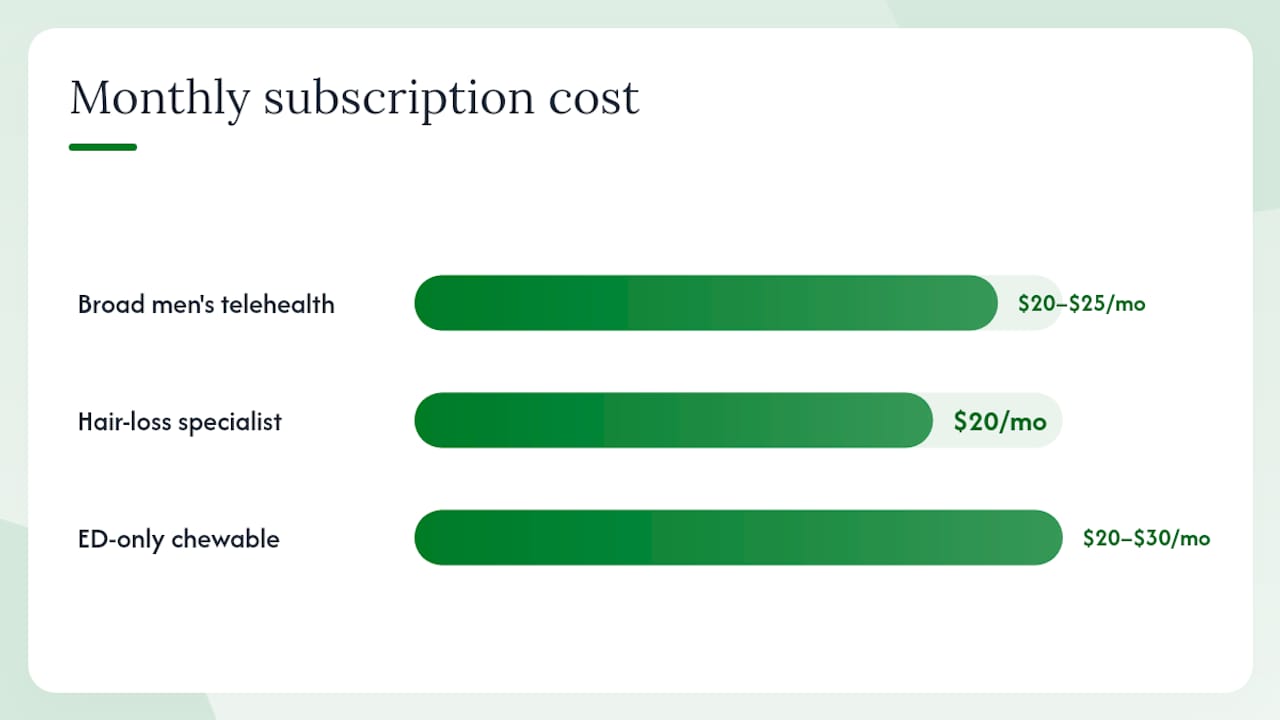
- Subscription or ongoing care program: Monthly or quarterly fees that bundle provider access, follow-up check-ins, and sometimes medication fulfillment. These tend to offer better value for patients who need long-term treatment, which most hair-loss cases do.
- Program fees that include medication and shipping: Some platforms bundle the consultation, prescription, and medication delivery into a flat monthly rate.
Insurance coverage:
- Private insurance plans increasingly cover telehealth dermatology visits, but coverage depends on your specific plan and state.
- Medicare covers some telehealth services, though coverage rules have shifted over recent years and vary by service type.
- Medicaid coverage for telehealth dermatology varies significantly by state.
- Many hair-loss consultations are paid out of pocket, particularly when the platform does not accept insurance directly.
Check with your insurer before booking. Ask specifically whether “teledermatology” or “asynchronous store-and-forward dermatology” is a covered benefit under your plan. Some plans cover the visit but not the medication; others cover both.
What to look for in pricing transparency: A trustworthy platform lists its fees clearly before you enter payment information, explains what is included in each tier, and has a stated refund or cancellation policy. Bundled medication options can reduce total cost significantly compared with paying separately for the visit and the prescription.
How do you choose the right online hair-loss doctor?
Start with the single most important filter: does the platform give you access to a board-certified dermatologist who is licensed in your state? If the answer is unclear or the platform cannot confirm it, move on.
Practical checklist before you book:
- Turnaround time stated clearly (24–48 hours standard, same-day available?)
- Follow-up visits included or available at a reasonable cost
- Explicit list of medications the platform can prescribe
- Labs and monitoring policy (what happens if you need bloodwork?)
- Refund and cancellation policy in writing
- Privacy policy that explicitly states HIPAA compliance
- Clear pathway to in-person referral if telehealth is not sufficient
Red flags that should stop you:
- The platform pushes only one branded product with no clinical rationale
- No physician or licensed clinician is named or listed
- Licensure information is absent or vague
- No follow-up care is offered after the initial prescription
- Refund policy is buried or nonexistent
Topweightlossmed checks the practical boxes: board-certified clinicians, same-day or 24–48 hour review, transparent pricing, medication delivery, and continuity of care across multiple health concerns. For women specifically, TWL’s female hair loss resources address spironolactone pathways, pregnancy testing requirements, and female-pattern-specific treatment plans.
Pro Tip: Read the platform’s FAQ before booking. A platform that answers hard questions about what it cannot treat, what happens if you need a biopsy, and how it handles abnormal labs is one that has thought carefully about patient safety.
When telehealth is not enough: limits of online hair-loss diagnosis
Telehealth works well for pattern hair loss and many common causes, but it has real limits. The Mayo Clinic notes that diagnosis may require medical history, physical exam, and sometimes laboratory testing or biopsy, depending on the presentation.
Go in person if you notice any of these:
- Rapidly spreading hair loss over days or weeks
- Painful, scaly, or inflamed scalp
- Sudden complete patches of hair loss with concerning features (blistering, scarring, skin changes)
- Systemic symptoms alongside shedding (fatigue, weight change, joint pain)
- Failed empiric therapy after 6–12 months with no response
- Abnormal lab results that need clinical interpretation
Scarring alopecias (lichen planopilaris, frontal fibrosing alopecia, discoid lupus) are particularly important to catch early because the follicle damage is permanent. A photo review alone may not distinguish these from non-scarring types reliably. The American Academy of Dermatology identifies several causes of hair loss that require in-person evaluation and targeted testing.
Diagnostic tests that require in-person visits:
- Scalp biopsy (definitive for scarring alopecia and uncertain diagnoses)
- KOH preparation for tinea capitis (fungal infection)
- Blood work: CBC, thyroid panel, ferritin, DHEA-S, and others depending on clinical picture
- Dermoscopy (trichoscopy) for detailed follicle-level assessment
Differential diagnosis for hair loss, including distinguishing androgenetic alopecia from telogen effluvium and alopecia areata, sometimes requires more than a photo. A good online provider will tell you when your case needs escalation rather than pushing a prescription that may not fit.
What the evidence says about finasteride and minoxidil
Both finasteride and topical minoxidil have randomized controlled trial evidence supporting their use for androgenetic alopecia. Systematic reviews confirm clinical benefit for many patients, with individual response and time to effect varying considerably.
What the evidence shows:
- Finasteride reduces scalp DHT levels and has demonstrated benefit for male pattern hair loss in multiple RCTs, with most patients seeing stabilization or regrowth after 6–12 months of consistent use.
- Topical minoxidil prolongs the anagen (growth) phase of the hair cycle and is effective for both male and female pattern hair loss. Results typically appear at 3–6 months.
- Spironolactone has observational and smaller trial evidence for female pattern hair loss; it is commonly used off-label and generally well-tolerated when monitored appropriately.
- Topical corticosteroids have evidence for alopecia areata, particularly for limited or patchy presentations.
Side effects and monitoring:
- Finasteride: Sexual side effects (reduced libido, erectile dysfunction) are reported by a subset of users. Clinical literature and safety reviews note these are generally reversible on discontinuation, though persistence has been reported in rare cases. Not for use in women of childbearing potential.
- Topical minoxidil: Local irritation, scalp dryness, and initial shedding (telogen effluvium) in the first 4–8 weeks are common. Systemic absorption is low with topical formulations.
- Spironolactone: Requires pregnancy test before initiation. Potassium monitoring is recommended for some patients. Menstrual irregularity is possible.
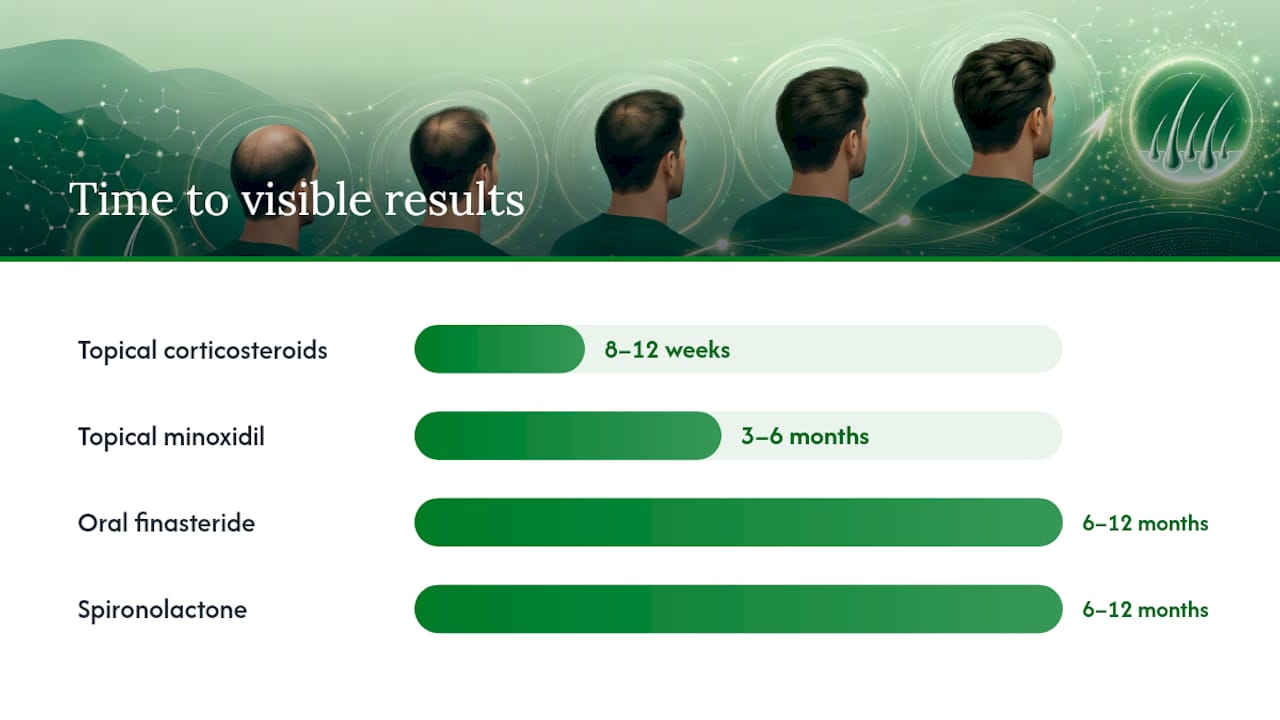
| Medication | Typical candidate | Evidence tier | Onset of visible results | Key monitoring |
|---|---|---|---|---|
| Oral finasteride | Men with androgenetic alopecia | Multiple RCTs | 6–12 months | Baseline PSA in older men; sexual side effects |
| Topical minoxidil | Men and women, pattern loss | Multiple RCTs | 3–6 months | Scalp tolerance; initial shedding |
| Spironolactone | Women with pattern or androgen-driven loss | Observational/smaller trials | 6–12 months | Pregnancy test; potassium levels |
| Topical corticosteroids | Alopecia areata (limited/patchy) | RCTs for limited disease | 8–12 weeks | Skin atrophy with prolonged use |
Why telehealth is often the right first move for hair loss
Telehealth is a practical and safe first step for most people dealing with pattern hair loss, and the evidence supports starting there rather than waiting months for an in-person dermatology slot. The medications with the strongest evidence, finasteride and topical minoxidil, are well-suited to remote prescribing because they do not require a physical exam to initiate safely in most cases.
What gets underestimated is how much the access gap costs patients. Dermatology wait times in many U.S. markets run 30–90 days for a new patient appointment. Hair loss is progressive. Every month without treatment is follicle miniaturization that cannot be reversed. Starting with a telehealth visit does not mean settling for less rigorous care. It means getting a clinically sound evaluation faster, with a clear escalation path if the case turns out to need more.
The caveat is real: telehealth works best when the provider is transparent about its limits. A platform that tells you upfront when your case needs a biopsy or in-person trichoscopy is one worth trusting. Monitoring, follow-up, and referral processes are standard practice on reputable platforms, and they are what separate a legitimate telehealth provider from one that just wants to move product.
Topweightlossmed connects you with board-certified hair-loss care today
Skipping a months-long dermatology waitlist is the concrete advantage Topweightlossmed offers patients who need hair-loss care now. TWL connects you with board-certified clinicians for online diagnosis, e-prescribing, and medication delivery or pharmacy pickup, all from home.
TWL’s hair-loss service covers both male and female pattern loss, with same-day or 24–48 hour provider review, transparent pricing, and continuity across primary care and other health concerns on the same platform. Female patients have access to dedicated clinical pathways including spironolactone evaluation and the pregnancy testing guidance that comes with it.
To get started, visit TWL’s hair loss page and book your appointment. Have your photos ready (crown, hairline, temples in natural light), a list of current medications, and any recent lab results if you have them. A clinician will review your case and send a treatment plan, often the same day.
Sources
The clinical summaries and patient guidance in this article draw from peer-reviewed research, specialty society guidance, and established patient-facing medical resources. Use these when evaluating treatment options or preparing questions for your provider.
When using these sources to inform a telehealth decision, focus on the diagnostic criteria and red flags sections. If your presentation matches any of the warning signs described, bring those details to your provider at the start of the consultation.
This article is general information, not a substitute for advice from a qualified doctor. Consult a qualified healthcare professional about your own circumstances before acting on anything here.
FAQ
Can I get a hair-loss prescription online?
Yes. Board-certified dermatologists and licensed clinicians can e-prescribe finasteride, topical minoxidil, spironolactone, and topical corticosteroids via telehealth in most U.S. states. Topweightlossmed offers this service with same-day or 24–48 hour provider review.
What shampoo does a dermatologist recommend for hair loss?
Dermatologists commonly recommend ketoconazole shampoo (such as Nizoral) for scalp inflammation and seborrheic dermatitis-related shedding, and zinc pyrithione shampoos for general scalp health. These are adjuncts, not replacements, for prescription treatment.
Is there a natural DHT blocker?
Saw palmetto is the most studied natural DHT blocker, but evidence from Healthline and clinical reviews shows the human data is limited and inconsistent compared with finasteride. No natural supplement has matched finasteride’s RCT evidence for androgenetic alopecia.
Can oils help reverse hair thinning?
Limited evidence exists for certain oils. Lavender oil has shown some signal in small animal studies, but human trial data is sparse. Oils may support scalp health and reduce breakage, but they do not address the hormonal or genetic drivers of pattern hair loss the way prescription medications do.
When does hair loss require an in-person visit instead of telehealth?
Seek in-person care for rapidly spreading or painful hair loss, suspected scarring alopecia, complete bald patches with skin changes, systemic symptoms alongside shedding, or when a scalp biopsy or blood work is needed to confirm the diagnosis.