Semaglutide, sold under FDA-approved brand names like Wegovy, Ozempic, and Rybelsus, can be used safely for weight management when a licensed clinician prescribes it, screens you properly, and follows a slow titration schedule with real follow-up. Some telehealth platforms build their programs around that oversight model. The single biggest safety variable isn’t the drug itself. It’s whether the telehealth provider actually monitors you after the prescription ships.
TL;DR:
- Telehealth-prescribed semaglutide is safe when overseen by licensed clinicians who conduct proper screening, manage gradual dose escalation, and ensure follow-up, matching in-person safety profiles.
- Side effects like nausea, vomiting, and constipation are common and typically occur around dose increases, with serious risks such as pancreatitis or kidney injury linked to poor monitoring or unapproved products.
- Verifying the legitimacy of pharmacies and prescriptions by confirming licensing and following FDA guidance can prevent most safety issues associated with unapproved or mislabeled products.
- Immediate medical attention is necessary for severe symptoms such as persistent abdominal pain, repeated vomiting, sudden vision changes, or allergic reactions, rather than delaying or ignoring them.
- Following prescribed titration schedules, monitoring for symptoms, and maintaining documentation reduces dosing errors and enhances safety during telehealth semaglutide treatment.
Table of Contents
- What Does the Evidence Say About Compounded Semaglutide Safety?
- What Side Effects Should You Expect, and What Needs a Clinician’s Attention?
- How Does Dosing and Titration Affect Safety?
- What Should You Verify Before Starting Telehealth Semaglutide Treatment?
- What Symptoms Mean You Should Stop and Call for Help?
- What Are the Legal and Liability Considerations With Telehealth Semaglutide?
- An Editor’s Take on Safe Telehealth Prescribing
- Getting Supervised Semaglutide Care Through TWL
- Where to Read More
- Sources
- FAQ
What Does the Evidence Say About Compounded Semaglutide Safety?
The strongest recent data point comes from a 2025 retrospective cohort study on telehealth-initiated semaglutide, which tracked patients using FDA-approved semaglutide through virtual care. That matters because it confirms telehealth delivery doesn’t dilute effectiveness when the program is run correctly.
Side effects followed a predictable pattern. Neither number should surprise anyone who has read a semaglutide package insert. Both symptoms are the expected cost of slowing gastric emptying, which is the whole mechanism behind the drug’s appetite effect.
Statistic Callout: A 2025 cohort of telehealth patients on FDA-approved semaglutide lost an average of -16.6% of body weight at 68 weeks, with nausea/vomiting in 37.3% and constipation in 15.6% of cases.
The gap between a well-run program and a risky one shows up in oversight, not outcomes. When a telehealth provider handles screening, dosing, and follow-up the way an in-person endocrinologist would, safety profiles track closely with what shows up in semaglutide’s clinical monograph. When oversight is thin, though, risk climbs fast. The FDA has flagged dosing errors tied to unapproved products and warned patients to fill prescriptions only through state-licensed pharmacies with a valid prescription from a licensed provider. That single instruction, get your prescription from a real clinician and fill it at a real pharmacy, prevents most of the serious problems reported to date.
What Side Effects Should You Expect, and What Needs a Clinician’s Attention?
Most people on semaglutide feel it in their stomach before they feel it anywhere else. Gastrointestinal symptoms are the most common adverse effect by a wide margin, and they tend to cluster around dose increases rather than staying constant.
- Nausea and mild vomiting: usually peaks in the first few days after a dose increase, then fades.
- Constipation: often develops gradually and responds to hydration and fiber.
- Diarrhea: less common than constipation but can appear, especially early in treatment.
- Decreased appetite: expected and part of how the drug works, not itself a red flag.
- Fatigue or mild dizziness: sometimes tied to reduced calorie intake rather than the drug directly.
Rarer but more serious risks deserve real attention. Clinical monographs list pancreatitis, acute kidney injury from dehydration (usually triggered by prolonged vomiting or diarrhea), gallbladder disease, hypersensitivity reactions, and a thyroid C-cell tumor signal seen in rodent studies that makes the drug inappropriate for anyone with a personal or family history of medullary thyroid carcinoma or MEN2.
A responsible clinician builds monitoring around those risks from day one. That means asking about pancreatitis history and thyroid cancer history before the first prescription, checking kidney function if you report several days of vomiting or diarrhea, watching for diabetic retinopathy symptoms if you have type 2 diabetes, and reviewing every other medication you take, especially insulin or sulfonylureas, since combining them with semaglutide raises hypoglycemia risk.
Pro Tip: Keep a simple symptom log on your phone. Note the date of each dose, what you felt, and how severe it was on a 1 to 10 scale. It takes 30 seconds and gives your clinician something concrete to act on instead of a vague “I’ve felt off.”
For a deeper breakdown of what’s typical versus what’s a warning sign, TWL’s guide to semaglutide side effects covers the full symptom timeline.
How Does Dosing and Titration Affect Safety?
Semaglutide isn’t a drug you start at full strength. The whole safety strategy behind it is gradual dose escalation, giving your gut time to adjust before the next increase.
- Starting dose: treatment typically begins at a low introductory dose meant purely to build tolerance, not to produce weight loss.
- Step-up increases: doses usually rise in increments (commonly by 0.25 mg steps for injectable formulations) every four weeks, depending on how you tolerate the previous level.
- Maintenance dose: many patients land on a target maintenance dose, such as 2.4 mg weekly for Wegovy, though your clinician may hold at a lower dose if side effects are significant.
- Reassessment points: your prescriber should check in at each step, not just mail the next dose automatically.
Dosing errors are the most preventable safety failure in this category. FDA safety communications have documented hospitalizations tied to incorrect dose measurement and mislabeled products, almost always from escalating too fast or misreading syringe markings. Rotate your injection site each week, keep a written dosing log, and call your clinician before your next dose if you’re dealing with severe nausea, vomiting, or signs of dehydration rather than pushing through. TWL’s dosing and titration guide lays out the schedule in more detail if you want the specifics before your first appointment.
What Should You Verify Before Starting Telehealth Semaglutide Treatment?
A safe telehealth semaglutide program looks different from a risky one in ways you can actually check before you commit. FDA guidance on internet pharmacy oversight makes the point directly: legitimate programs name their dispensing pharmacy and provide a written plan. Vague answers are the tell.
- Confirm the clinician is licensed in your state and reachable for follow-up questions, not just a one-time consult.
- Ask which pharmacy fills the prescription and verify it’s a named, state-licensed pharmacy, not an unnamed “partner facility.”
- Get the exact medication name and milligram dose in writing before you pay for anything.
- Confirm a follow-up schedule exists, typically checkpoints around one month, three months, and six months.
- Request a written titration plan and clear instructions for what to do if you miss a dose or have a severe reaction.
Statistic Callout: State pharmacy boards have grown more active in scrutinizing telehealth GLP-1 dispensing, with rules varying enough by state that verifying your pharmacy’s license in your own state is worth the two minutes it takes.
Red flags worth walking away from: a provider that won’t name its pharmacy, medication that arrives without proper labeling, pricing that seems far below what a branded FDA-approved product should cost, or radio silence from the clinician after your order ships. If you’re not sure how the process should work end to end, TWL’s guide to getting a semaglutide prescription online walks through what a legitimate visit actually involves.
What Symptoms Mean You Should Stop and Call for Help?
Most side effects are manageable at home. A short list of symptoms is not, and they call for immediate action rather than waiting out your next scheduled check-in.
- Severe, persistent abdominal pain, especially pain that radiates to your back, which can signal pancreatitis and needs same-day evaluation.
- Repeated vomiting with dehydration signs (dizziness, dark urine, confusion), which raises acute kidney injury risk.
- Sudden vision changes, which need prompt attention, particularly if you have diabetes.
- Difficulty breathing or swallowing, facial swelling, or hives, which can indicate a hypersensitivity reaction.
- Severe hypoglycemia symptoms (shakiness, confusion, fainting), especially if you also take insulin or a sulfonylurea.
Pause your next dose and contact your prescribing clinician immediately if symptoms are moderate; call emergency services if they’re severe or rapidly worsening. Keep your medication label, pharmacy contact number, and clinician’s number somewhere easy to find, an emergency team will want that information fast.
What Are the Legal and Liability Considerations With Telehealth Semaglutide?
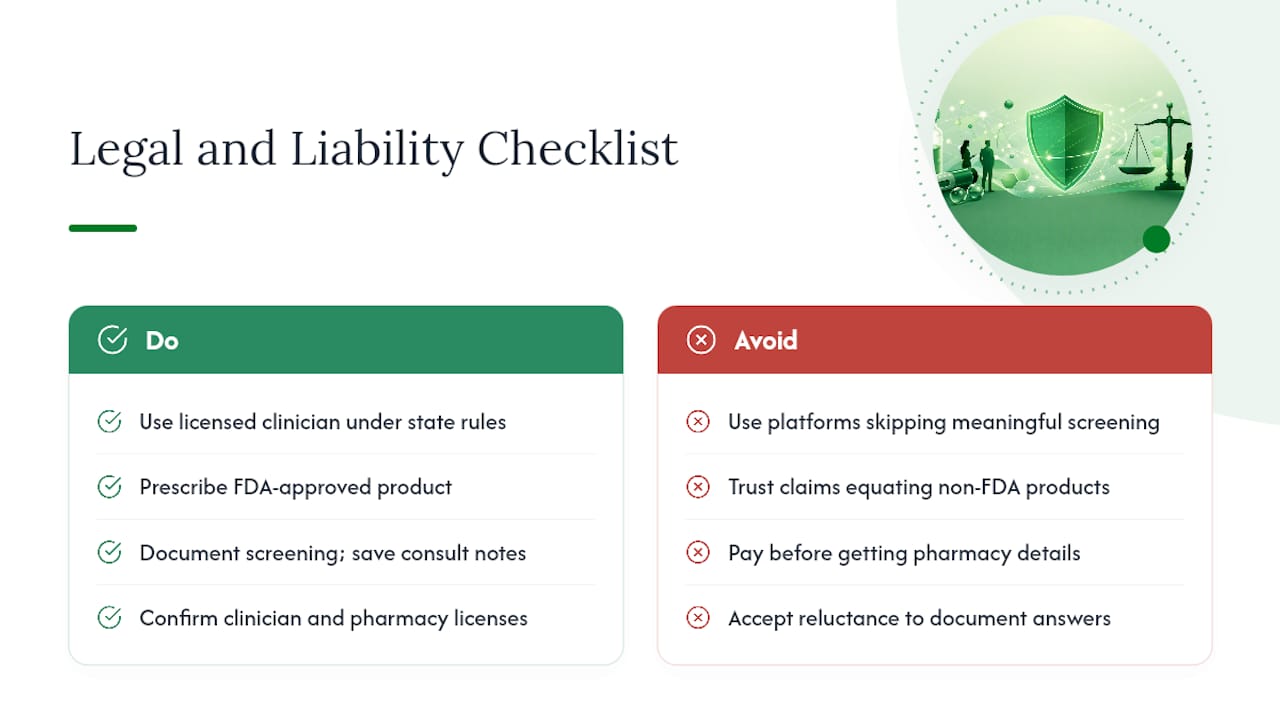
Prescribing FDA-approved semaglutide through telehealth is legal across the United States, but the legal exposure shifts depending on who’s writing the prescription and how. A licensed clinician practicing within their state’s telehealth rules, prescribing an FDA-approved product, and documenting proper screening carries the same liability standard as an in-person doctor. That’s a known, bounded risk, and it’s the model reputable platforms build around.
The murkier territory involves platforms that skip meaningful screening or make marketing claims implying their product is equivalent to an FDA-approved drug when it isn’t. The FDA has directly warned telehealth companies about misleading promotional claims, and state medical and pharmacy boards have started enforcing against providers operating outside their licensing scope. If something goes wrong with a poorly supervised prescription, the patient often has limited recourse, especially if the dispensing pharmacy isn’t even named on the paperwork.
Your practical protection here is documentation. Save every consult note, prescription record, and pharmacy receipt. Confirm your clinician’s license number and your pharmacy’s state license before you pay. If a provider discourages you from asking these questions or won’t put answers in writing, treat that reluctance as the clearest signal available that liability protection on your end is thin. Legitimate telehealth medicine has no reason to hide its paperwork.
An Editor’s Take on Safe Telehealth Prescribing
The safety conversation around semaglutide gets flattened into “is the drug safe” when the real question is “is the process safe.” Clinician oversight, a written dosing plan, and follow-up appointments you actually keep matter more than any single side effect statistic. Some programs build around that structure for a reason: continuity of care isn’t a nice extra, it’s the mechanism that catches problems before they become emergencies. Document every answer your provider gives you, and don’t skip a follow-up just because you’re feeling fine.
— Bryan
Getting Supervised Semaglutide Care Through TWL
Some telehealth providers run their weight-loss programs with safeguards like licensed clinicians, virtual appointments, documented dosing plans, and medication delivery paired with follow-up rather than a one-time script. That combination is what separates supervised care from the riskier corners of the telehealth market.
You can review how TWL structures monitoring and side-effect guidance on its GLP-1 safety information page, then book a consultation through the Weight Loss Program page to get matched with a provider and start a proper screening and titration schedule instead of guessing at your own dosing.
Where to Read More
The FDA’s guidance on unapproved GLP-1 drugs lays out prescription and pharmacy verification steps. The Weill Cornell retrospective cohort study documents telehealth outcomes and adverse-event rates. The NCBI clinical monograph details adverse effects and monitoring protocols. Mayo Clinic’s drug information page offers patient-facing counseling points.
This article is general information, not a substitute for advice from a qualified doctor. Consult a qualified healthcare professional about your own circumstances before acting on anything here.
Sources
- Retrospective cohort on telehealth-initiated semaglutide outcomes (2025)
- FDA: Concerns with unapproved GLP-1 drugs used for weight loss
- Semaglutide safety and adverse effects — NCBI clinical monograph (2024)
- Mayo Clinic: Semaglutide (subcutaneous) drug information
FAQ
Is Semaglutide Safe When Prescribed Through Telehealth?
Yes, when a licensed clinician screens you, follows a slow titration schedule, and schedules real follow-up, semaglutide’s safety profile through telehealth matches what’s seen in clinical settings. The 2025 cohort study found outcomes and side-effect rates consistent with in-person prescribing.
What Are the Most Common Semaglutide Side Effects?
Nausea, vomiting, and constipation are the most frequently reported side effects, with one cohort reporting nausea/vomiting in 37.3% of patients and constipation in 15.6%. Most symptoms cluster around dose increases and ease over time.
How Do I Know a Compounding Pharmacy or Telehealth Pharmacy Is Legitimate?
Ask your provider to name the exact dispensing pharmacy and confirm it holds an active state license. The FDA advises filling prescriptions only through state-licensed pharmacies with a valid prescription from a licensed provider.
When Should I Stop Taking Semaglutide and Call a Doctor?
Stop and call your clinician immediately for severe abdominal pain, repeated vomiting with dehydration signs, sudden vision changes, or any sign of an allergic reaction. Call emergency services if symptoms are severe or rapidly worsening.
Does Top Weight Loss Med Offer Supervised Semaglutide Programs?
Yes, TWL’s Weight Loss Program pairs licensed clinicians with medication delivery, dosing guidance, and scheduled follow-up. Pricing details for the program are available directly on the TWL website.